
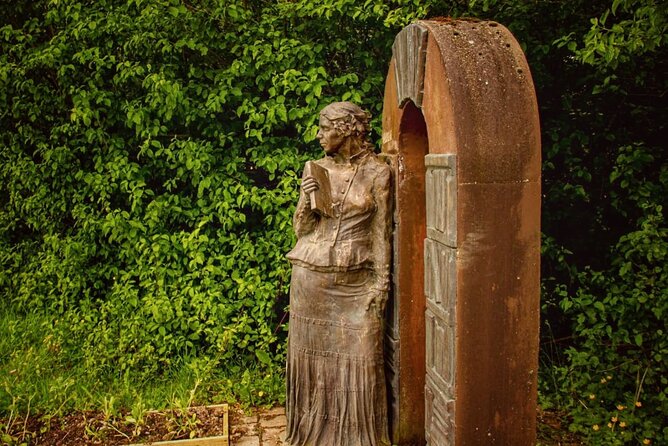
Reviewed · SELF-GUIDED TOURS
Maria Edgeworth Center-A Self-Guided Audio Tour
Maria Edgeworth’s story comes alive in a former 1840 school building, where books, portraits, letters, and an old classroom setting explain both her writing career and her family’s work in education. I like the clear focus on Maria as a major English-language novelist, and I like the local links to Oliver Goldsmith, Walter Scott, Wordsworth, and Oscar Wilde. The main consideration is that this is a small museum, so readers wanting a large collection or a long guided tour may finish quickly.
I also like the freedom of an English self-guided audio tour. You can move at your own pace, stop to study an artifact, or spend extra time on the schoolroom and family displays. Matt and Janine are available to welcome you and provide context, but the formal experience remains flexible rather than tied to a group schedule.
Key points at a glance
- Maria Edgeworth in her own setting: Learn about one of the best-known English-language novelists of her age inside a former schoolhouse connected with her family.
- A family of writers and reformers: The displays cover Maria, her father Richard Lovell Edgeworth, and the family’s work in science, surveying, education, and public life.
- A recreated 19th-century schoolroom: Hear how hedge schools developed and how the Edgeworth family helped push education higher on Ireland’s public agenda.
- Useful local connections: The audio tour links Edgeworthstown with Oliver Goldsmith, Sir Walter Scott, William Wordsworth, and Oscar Wilde.
- Good value for a short stop: At $9 per person, the visit works well as a focused hour-long activity, with extra time available for careful reading.
Why Maria Edgeworth’s story matters here
Maria Edgeworth is often introduced as a contemporary of Jane Austen and Lord Byron. That comparison helps place her in time, but the centre gives you more than a literary name beside famous names. It presents her as a successful author who worked within a highly unusual family circle and wrote during a period when ideas about education, society, and class were changing.
The museum also helps explain why Maria’s work can feel larger than a standard author display. Her father, Richard Lovell Edgeworth, was an inventor, surveyor, and educator. His interests shaped the household around her, and the family’s approach to learning forms a major part of what you see and hear.
I find that useful because Maria’s literary career did not develop in isolation. The displays connect her writing with a wider family effort to understand how people learn, how children should be educated, and how social conditions affect ordinary life. You get a portrait of an author, but also of a family trying to put ideas into practice.
The audio format is a good match for this subject. A written panel can give you dates and names, but a spoken account can connect the family tree, local buildings, books, and historical events in a more natural order. You can listen, look around, and pause when a particular object catches your attention.
More self-guided routes in Ireland:
- St Patrick’s Cathedral: Self-Guided Cathedral Admission
★ 4.5 · 2,126 reviews - Christ Church Cathedral Entrance Ticket & Self-Guided Tour
★ 4.6 · 773 reviews - Self-Guided Bike Tour of Killarney National Park, Muckross Gardens & Waterfall
★ 5.0 · 223 reviews
Entering the former 1840 school building
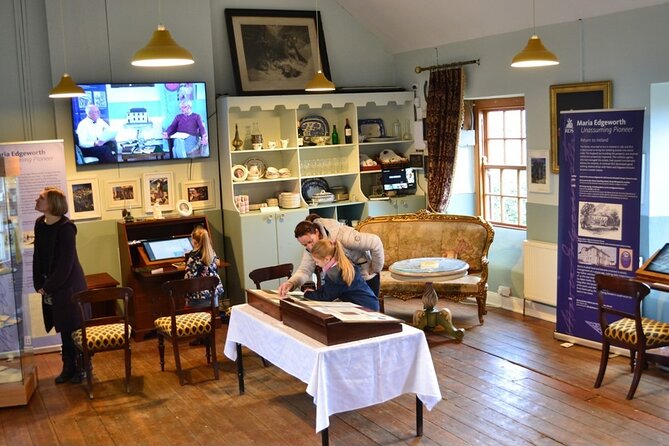
The Maria Edgeworth Centre is located in an old school building dating from 1840. That setting gives the visit a useful sense of place. You are not simply entering a modern room filled with panels about education. You are seeing the story in a building that was itself part of the school tradition being discussed.
The rooms are arranged to present the Edgeworth family, with particular attention given to Maria. Expect portraits, books, letters, family material, and other artifacts, including objects dating as far back as the 18th century. The displays are intended to be read and explored, so this is a stop for people who enjoy taking their time with labels and small details.
Staff members Matt and Janine may help you get started. Janine has been described as offering visitors a useful introduction to Maria and pointing out the achievements of Maria’s parents and siblings. Matt also leads local historical walks, and one possible way to use the centre is to combine the self-guided visit with a town walk when that option is available.
You should not expect a large institutional museum. The appeal is the personal scale. You can focus on a family letter, a portrait, or a classroom object without being swept through a huge building. For a short visit in Edgeworthstown, that focused approach is part of the value.
The audio tour and its one-hour rhythm
The listed duration is about one hour to one hour and 30 minutes. That is a sensible planning estimate if you listen through the main material and pause at the displays. If you read every panel closely, study the books and letters, and take time with the schoolroom, you may want longer.
One visit to the centre lasted around three hours while the visitor worked through the audio guide, images, and letters. That is not the normal minimum time, but it tells you something important: the centre can support a quick stop or a more patient literary visit. Your pace will depend on how much Maria Edgeworth already interests you.
The audio tour is offered in English and comes as a mobile ticket experience. It is self-guided, so you are not locked into the speed of a live group. That makes it easier to stop and reread something, listen again, or move ahead if one section is less important to you.
I would plan on at least 60 minutes, then leave room if you are reading Maria’s letters or tracing the family connections. A rushed 20-minute visit would miss much of the point. The centre is small enough to fit into a wider day in the area, but it rewards attention rather than a quick photograph and exit.
The recreated schoolroom and Ireland’s education story
The recreated 19th-century schoolroom is one of the most distinctive parts of the visit. It gives the education story a physical setting and helps you picture the kind of room in which lessons took place. The audio explains the origins of Ireland’s hedge schools, an important part of the country’s educational past.
The centre also covers the Edgeworth family’s efforts to make education a government priority. It then connects those efforts with the creation of the Primary School System in 1831, in which members of the Edgeworth family played an important role.
This section broadens the visit beyond literary biography. You learn why the family’s name matters in Irish education, not just in fiction. It also shows how Maria’s world included practical debates about schooling, access to learning, and the role of government.
I would give the schoolroom proper time, even if you came mainly for the novels. It is the clearest way to understand the forward-looking side of the Edgeworth family. Older visitors may also find familiar echoes in the discussion of school systems and classroom life, while younger visitors can see how different education once looked.
A few more Ireland half-days to weigh up
- Cork: City Gaol Tour with Audio Guide
★ 4.8 · 108 reviews - Medieval Mile Museum Self Guided Audio Tour
★ 5.0 · 91 reviews - Galway’s City Centre: A Self-Guided Audio Tour
★ 5.0 · 7 reviews - The Mystical Hill of Tara: A Self-Guided Audio Tour
★ 3.5 · 6 reviews
Books, letters, and the family around Maria
The centre’s objects help turn a list of names into a family story. Portraits show the people around Maria, while books and letters point to the work of writing, reading, and correspondence. The family tree can also help if you are already reading about Maria or trying to sort out her connections.
The focus remains on Maria, but her parents and siblings matter here. The Edgeworth family’s interests ranged across science, invention, surveying, teaching, and literature. That mix makes the centre more interesting than a single-author room with a few first editions.
You might find the letters especially rewarding if you are interested in Maria’s voice rather than just her biography. The written material adds a personal layer to the audio narrative. It also helps explain why the centre can take longer for visitors who want to read rather than simply listen.
A practical tip is to bring enough attention for names and relationships. There is a lot packed into the rooms, and the material covers several generations and subjects. If you are tracing family history in Ireland, tell the staff what you are looking for. A visitor with Akenham family connections received help and found the centre particularly useful for that purpose.
Edgeworthstown and its literary connections
The visit is rooted in Edgeworthstown, so the local story matters as much as the famous names. The audio includes stories from the town’s past and explains connections with Oliver Goldsmith, Sir Walter Scott, William Wordsworth, and Oscar Wilde.
These links give you a wider view of the period. Maria was not writing in a vacuum, and her literary world included writers whose names still shape how we think about English-language literature. The centre uses those connections to place her career in a larger cultural setting.
A historical walk with Matt can add another layer if you can arrange it as part of your visit. One visit paired a town walk with the self-guided centre tour, creating a fuller picture of the Edgeworth family and the places connected with them. The audio tour itself is the core activity, but the town setting helps you understand why the museum is located here.
Do not expect a full walking tour to be included in the $9 admission. The listed experience is the centre and its self-guided audio program. Ask locally about any separate walk or special event if you want more time outdoors.
How much value do you get for $9?
At $9 per person, this is reasonably priced for a focused cultural stop. The admission includes the centre and the audio experience, and the subject is specific enough to offer something you will not get from a general Ireland history museum.
The value depends on your interests. If Maria Edgeworth, Irish literature, local history, or education reform appeal to you, the price is easy to justify. You get a guided narrative, historic objects, a recreated classroom, and material tied directly to the town.
If you know little about Maria and are unsure how much literary history you want, the one-hour format reduces the risk. This is not a costly half-day commitment. You can learn the essentials, then decide if you want to spend longer with the books and letters.
The centre also works well for people tracing family connections. The Akenham connection mentioned by one visitor shows how local museums can be especially useful when your interest is personal rather than purely academic. Bring names and family details if you have them, and ask Janine or another staff member for help.
Practical details before you go
You receive confirmation at booking, and the experience is available with a mobile ticket. It is offered in English. Service animals are allowed, and the centre is near public transportation.
Most people can participate, but the available information does not provide detailed measurements for entrances, seating, or every room. If you have specific access needs, contact the Maria Edgeworth Centre before booking so you can check the arrangements directly.
The centre has seating outside, and tea or coffee may be available. Treat that as a possible extra rather than a guaranteed part of the ticket. Payment facilities have been raised as a practical issue during quieter periods, so carrying a backup payment method is sensible.
Free cancellation is available if you cancel at least 24 hours before the local start time. Cancellations or changes made inside that period are not accepted for a refund.
Who will enjoy this most?
I would recommend the centre to readers who like literary biography with a strong local connection. It suits anyone curious about Jane Austen’s contemporaries, Irish writing, 18th and 19th-century social change, or the development of education in Ireland.
It is also a good choice for family-history research. The staff can help orient you, and the displays may clarify names and relationships that are hard to follow in a book.
Parents and grandparents may appreciate the schoolroom section, especially if education history is part of their interests. The small scale also makes the centre manageable for a morning or afternoon stop.
I would be less likely to recommend it to someone seeking a major art collection, a large number of original manuscripts, or a full-day attraction. The centre is intimate and focused. Its strength is the quality of the story and the connection between the building, the family, and the town.
Should you book the Maria Edgeworth Centre?
Book it if you want a thoughtful, low-cost stop that connects one author’s life with Irish education and local history. The 4.9 rating from 21 published responses and 100 percent recommendation rate fit the experience described by the material: personal, well organized, and packed with useful detail.
The best plan is to allow 60 to 90 minutes, then stay longer if the letters, books, or family story take hold. If possible, speak with Matt or Janine when you arrive, and ask about any separate town walk or local event.
Skip it only if your schedule is so tight that you cannot give the audio and displays proper attention, or if you want a major national museum rather than a small specialist centre. For most readers with an interest in Maria Edgeworth or Edgeworthstown, $9 buys a worthwhile hour and a more lasting sense of the people behind the name.
FAQ
How long does the Maria Edgeworth audio tour take?
The expected duration is approximately one hour to one hour and 30 minutes. You may spend longer if you read the displays carefully or take extra time with the books, letters, and artifacts.
What language is the audio tour offered in?
The self-guided audio tour is offered in English.
Is admission included with the booking?
Yes. Admission to the Maria Edgeworth Visitor Centre is included.
What does the tour cover?
It covers Maria Edgeworth’s life and writing, the Edgeworth family, local stories from Edgeworthstown, literary connections with writers including Oliver Goldsmith and Sir Walter Scott, and the family’s work in education.
Is the centre suitable for most people?
Most people can participate. Service animals are allowed, and the centre is near public transportation. For specific accessibility questions, contact the centre before booking because detailed access information is not provided.
Can I cancel for a refund?
Yes. You can cancel for a full refund up to 24 hours before the experience start time. Changes or cancellations made less than 24 hours before the start time are not accepted for a refund.
Recently added around Ireland
- Killarney: Gap of Dunloe Day Tour★ 4.7 · 3 reviews
- Sean’s Bar, Athlone Castle and Clonmacnoise Monastery★ 4.5 · 3 reviews
- Dublin: Pub Tour. Pour The Perfect Guinness, Whiskey & Music★ 5.0 · 3 reviews
- Ferry ticket – Day return ticket to Inishbofin Island from Cleggan. Self Guided.★ 5.0 · 3 reviews
- Connemara/Galway: Inis Meáin Return Ferry Transfer★ 4.7 · 3 reviews
- Cork Private Walking Tour★ 5.0 · 3 reviews
- Waterford Crystal and Kilkenny Full-Day Rail Tour from Dublin★ 5.0 · 3 reviews
- (Christmas Morning) Glendalough Half Day Tour from Dublin★ 3.7 · 3 reviews
Self-Guided Tours, compared.
St Patrick’s Cathedral: Self-Guided Cathedral Admission
Read our review →
Christ Church Cathedral Entrance Ticket & Self-Guided Tour
Read our review →
Self-Guided Bike Tour of Killarney National Park, Muckross Gardens & Waterfall
Read our review →

Browse the lists this tour appears in