
Reviewed · DUBLIN TOURS
Dublin: Hidden Gem Walking Tour with Local Guide
Tallaght may not be the first place you think of for Dublin history, and that is exactly what makes this walk interesting. With local guide Sophie, you move from Kingswood to Tallaght Village, tracing writers, war correspondents, poets, monks, chocolate makers, aviation, rebellion, and the Irish language.
I like the small maximum of 12 people, which should make it easier to ask questions and follow the stories. I also like the range: Katharine Tynan and Alice Furlong bring literature and language into the walk, while Urney Chocolates, Jacob’s, and the old aerodrome show how ordinary work and industry changed Tallaght.
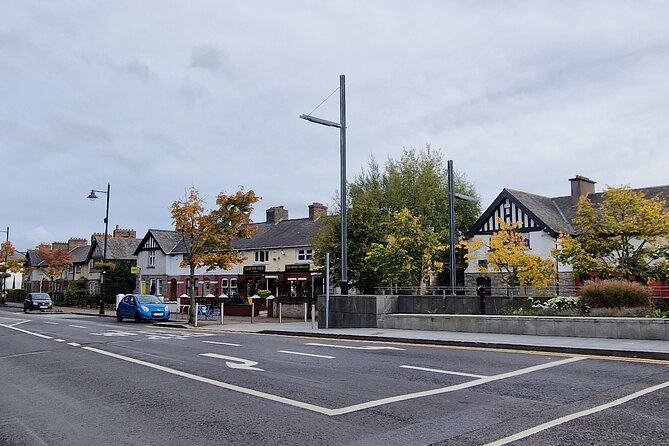
The main consideration is that this is an outdoor walk through modern suburban streets and public spaces, not a parade of grand historic buildings. The tour also depends on good weather, so bring suitable clothing and be ready for several short stops rather than one long visit at a single site.
Key points about the Tallaght walking tour
- Ten short stops connect rural Tallaght with the modern town: The route covers ancient monastic life, literary circles, rebellion, aviation, industry, and urban growth.
- Sophie brings local voices into the story: Expect extracts from letters, poems, newspaper writing, and Irish-language material rather than only dates and names.
- Katharine Tynan and Alice Furlong are central figures: Their lives show Tallaght’s links to Irish writing, the Irish Renaissance, nationalism, and language revival.
- The Dublin Mountains provide a visual link to mythology: A view of the mountains helps frame the bilingual story of Oisín in the Land of Youth.
- The route finishes beside a bilingual café in Tallaght Village: You learn a few basic Irish words and can use them locally after the walk.
- At $18.05, the tour offers a low-cost way to see another side of Dublin: It is best value for people who enjoy stories, local detail, and places outside the usual city-center circuit.
Why Tallaght makes a surprising history walk
This tour asks you to rethink Tallaght. It is often treated as a large modern suburb, but the area reaches back to early Irish monastic life and has links to major figures in literature, journalism, politics, business, and language.
The route does not present Tallaght as a preserved old town from end to end. Instead, it shows you the layers. A road, retail park, churchyard, or college campus can carry traces of an earlier place, and Sophie uses those settings to explain how the area changed.
That approach suits you if you enjoy seeing how history survives in everyday surroundings. It is less suited to you if you want a compact old-city walk with a historic building at every turn.
The tour takes about two hours and is offered in English. You receive a mobile ticket, and the group is capped at 12 people. At an advertised price of $18.05 per person, I see this as a modest investment for a focused local tour, especially since the guide shares material that is hard to pick up from a standard Dublin sightseeing route.
More Walking Tours in Dublin
- Dublin Highlights and Hidden Gems Guided Walking Tour
★ 5.0 · 6,020 reviews - Dublin: Highlights and Hidden Gems Walking Tour
★ 4.9 · 2,140 reviews - 1916 Rebellion Walking Tour
★ 5.0 · 1,605 reviews
Kingswood and Tallaght’s early beginnings
The walk starts in Kingswood, in the Kilnamanagh area of Dublin County. The opening stop is brief, only about five minutes, but it gives you an introduction to Tallaght and its place in early Irish history.
This is a useful beginning because the tour does not jump straight into modern housing estates or shopping areas. You first get a sense that Tallaght’s story began long before its rapid expansion in the late twentieth century.
The opening is short, so do not expect a lengthy archaeological presentation. Think of it as a starting point that sets up the much larger story ahead.
Whitehall and Katharine Tynan’s literary circle
Just outside, the tour reaches Whitehall, the former home of Katharine Tynan. This is one of the most distinctive stops because it connects a local residence with major literary figures of Ireland and England.
Sophie explains Tynan’s life and writing, along with her friendships with W.B. Yeats and George William Russell, who wrote under the name AE. Letters from Tynan to Yeats and Russell are shared, giving the stop a more personal feel than a simple account of literary dates.
Tynan was not merely connected to better-known writers. She made her own contribution to Irish writing, and her work is used here to show how Tallaght touched the literary circles of her time. I particularly like this part of the route because it places literary history in a home and neighborhood rather than leaving it inside a museum.
You spend about 15 minutes here. That is enough time for a focused introduction, though anyone wanting a full study of Tynan’s books will find the stop necessarily selective.
William Howard Russell, war reporting, and Tallaght
At Belgard Road, the focus shifts from poetry and fiction to journalism. William Howard Russell was born in Jobstown, Tallaght, and became one of the earliest figures associated with professional war reporting.
His career took him from reports on Daniel O’Connell’s meetings and the Great Famine in Ireland to the Crimean War and the American Civil War. The story also includes his friendship with Charles Dickens, adding another literary connection to the walk.
Sophie shares some of Russell’s writing and letters. That matters because war reporting can sound abstract when reduced to a list of campaigns. Original words give you a clearer sense of how he observed conflict and public life.
This stop lasts about ten minutes. It is a compact account of a long career, but it helps make the point that Tallaght produced people whose work reached far beyond Dublin.
A different sort of day from the same base:
- Dublin to Cliffs of Moher, including Wild Atlantic Way and Galway
★ 5.0 · 23,331 reviews - From Dublin: Cliffs of Moher, Burren & Galway City Day Tour
★ 4.8 · 18,888 reviews - Dublin: Guinness Storehouse Entry Ticket
★ 4.6 · 16,863 reviews - Dublin to Cliffs of Moher, Burren, Wild Atlantic Way, Galway Tour
★ 5.0 · 12,924 reviews
Oisín and the view toward the Dublin Mountains
The next stop also takes place around Belgard Road, but the subject changes again. Sophie gives you a short introduction to Irish mythology before telling the bilingual story of Oisín in the Land of Youth, known in Irish as Oisín i dTír na nÓg.
The story is presented in Irish and English. You do not need to speak Irish to follow it, and the English translation makes the tale accessible while allowing you to hear the original language.
The Dublin Mountains are visible from this point, linking the legend to the place around you. This is a good example of the tour’s method: a view is not treated as decoration but as part of a story.
You spend about ten minutes here. The stop will appeal to you if you like folklore and language, though it is not a full lesson in Irish mythology.
Tallaght Aerodrome, Urney Chocolates, and Jacob’s
At Belgard Retail Park, the tour moves into modern economic and social history. The site is associated with the former Tallaght Aerodrome, which played roles during the First World War, the Irish War of Independence, and the Irish Civil War.
The aerodrome was built on land connected with Katharine Tynan’s father, creating another link between Tallaght’s literary and political stories. A poem by Tynan about the development is shared here.
The same stop also introduces the Gallagher family and Urney Chocolates. The company became a familiar Irish brand and operated in Tallaght for decades before closing in 1980. Sophie also explains how the Urney name continues to live on, while briefly covering Jacob’s presence in Tallaght.
This is one of the strongest parts of the tour for anyone interested in everyday Ireland. Factories and food brands may not sound as dramatic as rebellion or mythology, but they reveal how people lived, worked, and remembered a place. A chocolate company can tell you plenty about local employment, Irish business, and childhood memories.
You spend about 15 minutes here. Since the former industrial sites are not presented as a preserved attraction, the value comes from the explanation and the connections Sophie makes.
The fast growth of Tallaght in the 1970s and 1980s
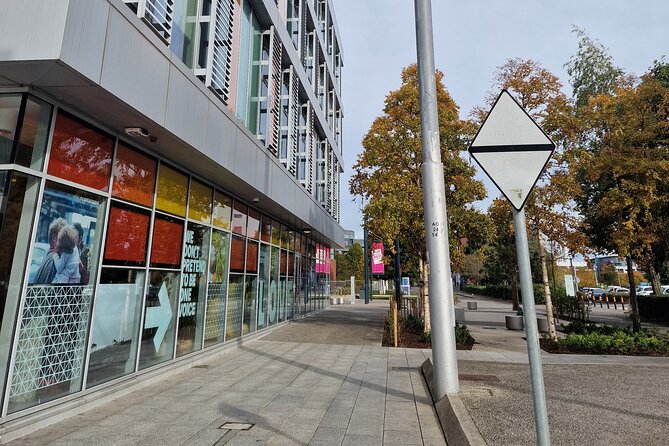
At TU Dublin’s Tallaght Campus, the tour examines the area’s rapid transformation. In only a few decades, Tallaght grew from a rural setting into one of Ireland’s largest urban areas. During the 1980s, it was among the fastest-growing urban centers in Western Europe.
Sophie places that growth against a difficult national backdrop of unemployment, economic strain, and emigration. This context is important. New homes and expanding roads were not simply signs of progress. They also brought pressure, adjustment, and major changes for the people already living in the area.
This stop helps you read the modern town with more care. What may look like ordinary urban expansion becomes part of a clear social story. You learn how Tallaght changed, why the growth happened so quickly, and how the area continued to develop after the 1970s and 1980s.
About 15 minutes are spent here. It is a useful pause in the route because it ties together the earlier stories of land, work, population, and local identity.
St Maelruain’s Church and the older Tallaght
The route then reaches St Maelruain’s Church of Ireland. The present church occupies the site of a former monastery that held major importance in early Ireland. Along with a monastery at Finglas, it was known as one of the two eyes of Ireland.
Sophie discusses St Maelruain and the earlier religious community before explaining how the present-day church came into being. This is where the age of Tallaght becomes easiest to picture. The modern town has grown around a place that once mattered greatly in early Irish religious life.
The stop itself lasts about five minutes, so the treatment is an overview rather than an extended church visit. The tour information does not promise interior access or a detailed architectural inspection. You should come for the story of the site and its place in Tallaght’s past.
Alice Furlong, Irish-language writing, and a neglected grave
On the church grounds, Sophie introduces Alice Furlong, who is buried there. Furlong was a founding member and vice-president of Inghinidhe na hÉireann, or Daughters of Ireland, and she was also a poet, writer, and advocate for the Irish language.
Her connection with Tallaght gives the churchyard stop a personal focus. Sophie shares poetry in both Irish and English, with professional English translations provided for the Irish-language work.
I like the balance here. You are not simply told that Furlong supported Irish. You hear some of her writing and see how language, place, and identity connected in her life. Her grave had been overlooked until fairly recently, so the stop also shows how important local interpretation can be in bringing lesser-known figures back into view.
This section lasts about 15 minutes and may be one of the most rewarding parts of the tour for anyone interested in Irish literature, women’s history, or language revival.
The Fenian Rising in Tallaght Village
In Tallaght Village, a plaque marks the Fenian Rising of 1867. Sophie explains the period and Tallaght’s role in it, adding writing by Charles Dickens about this part of Irish history.
The stop lasts about ten minutes. It is another example of the tour’s broad reach. Instead of treating rebellion as a distant national event, the walk asks what it meant in a particular Dublin community.
The plaque gives you a visible marker, but the explanation supplies the context. I would pay close attention here if you have a general interest in Irish independence but limited knowledge of how events played out outside central Dublin.
Cottages, the steam tramway, and a few words of Irish
The tour ends in the heart of Tallaght Village. You see cottages designed by architect Thomas Joseph Byrne, described as one of the most influential architects of his day, and learn about the former Dublin and Blessington Steam Tramway.
The tramway ran through the area until it closed in 1932. Its story adds another practical layer to the tour, showing how transport shaped the connection between Tallaght and Dublin before the modern town developed.
Sophie finishes by teaching you some basic Irish and talking about the language. The end point is beside a bilingual Irish and English café, where you are welcome to try your new phrases.
This is a friendly way to finish. It gives the tour a small practical link to present-day Tallaght rather than ending with a final date and a goodbye.
What the price and format mean for you
At $18.05 per person, this is inexpensive for a two-hour guided walk, especially with a small group and a local guide. The value is strongest if you enjoy interpretation, original writings, and connections between people and places.
You are not paying for admission to major attractions. All listed stops have free admission, and much of the experience takes place outdoors. The price mainly covers Sophie’s preparation, storytelling, and the selection of letters, poems, photographs, and historical material she brings into the walk.
The tour averages bookings about 28 days ahead, so planning early is sensible if your Dublin dates are fixed. Confirmation arrives when you book, and a mobile ticket is provided.
The meeting point is in Kingswood, while the tour ends in Tallaght Village. Because the start and finish differ, check your transport plan before setting out. The tour is near public transportation, and most people can take part, but you should still expect a full two hours on foot with stops along roads, public areas, and a churchyard.
The group size cannot exceed 12 people. That is a useful limit for a story-led walk, since large crowds can make letters, poems, and spoken Irish harder to follow.
Who should book this Tallaght experience?
I would choose this tour if you have already seen Dublin’s central sights and want a less familiar part of the county. It also suits Dublin residents who know Tallaght as a modern suburb but have never explored its earlier stories.
History fans will find plenty here, but you do not need specialist knowledge. The route covers literature, folklore, journalism, religion, industry, transport, urban planning, and politics in plain terms.
It is especially suitable for you if you enjoy:
- Local stories tied to real streets and buildings
- Irish writers and the development of the Irish language
- The history of ordinary businesses and workplaces
- Short readings from letters and poetry
- Small groups and conversational guiding
- Seeing how a rural area became a major urban center
You may prefer another Dublin activity if you want indoor attractions, extensive architecture, or a route concentrated in the historic center. The tour also requires good weather. If poor weather causes cancellation, you are offered another date or a full refund. You can cancel for a full refund up to 24 hours before the start time.
Should you book it?
Book this walk if you want to understand Tallaght beyond its modern reputation. Sophie’s route links Katharine Tynan, William Howard Russell, Alice Furlong, St Maelruain, the Fenian Rising, Urney Chocolates, the aerodrome, and the growth of the town into one readable local story.
The strongest reason to go is the range of material. You hear poems in Irish and English, see the Dublin Mountains in connection with mythology, and learn how factories and housing changed the area. At $18.05, that is a good deal for a two-hour introduction to a side of Dublin many visitors skip.
Choose it on a reasonably dry day, wear comfortable shoes, and arrive ready for a walking tour built around stories rather than grand monuments.
FAQ
Where does the tour start?
The tour starts in Kingswood, in the Kilnamanagh area of Dublin County.
Where does the tour end?
It ends in Tallaght Village at R819, beside a bilingual Irish and English café.
How long does the walking tour take?
The tour lasts approximately two hours.
What language is the tour offered in?
The tour is offered in English. Irish-language poetry and basic Irish phrases are also included, with English translations provided for the Irish poetry.
How large is the group?
The tour has a maximum of 12 participants.
What is included in the price?
The experience includes a local tour guide and a small-group tour. Admission to the listed stops is free.
Is the tour suitable for most people?
The activity information states that most people can participate. It is near public transportation, and service animals are allowed.
Can I cancel for a refund?
You can cancel at least 24 hours before the local start time for a full refund. Cancellations or changes made less than 24 hours before the start time are not accepted for a refund. If poor weather cancels the tour, you are offered another date or a full refund.
Recently added around Dublin
- Dublin: Pub Tour. Pour The Perfect Guinness, Whiskey & Music★ 5.0 · 3 reviews
- Waterford Crystal and Kilkenny Full-Day Rail Tour from Dublin★ 5.0 · 3 reviews
- Private Chauffeur Service From Dublin Airport to Killarney★ 5.0 · 3 reviews
- Cliffs of Moher and The Burren Private Tour from Dublin★ 5.0 · 3 reviews
- Beautiful Southwest Tour 2022★ 5.0 · 3 reviews
- A Self Guided Walking Tour of Dublin’s Docklands★ 4.5 · 3 reviews
- Dublin One Day Tour with a Local: 100% Personalized & Private★ 4.5 · 3 reviews
- Ireland: 3-Day West Coast Explorer Tour★ 5.0 · 3 reviews
Dublin Tours, compared.

Dublin to Cliffs of Moher, including Wild Atlantic Way and Galway
Read our review →
Cliffs of Moher, Burren & Galway City Day Tour
Read our review →

Dublin to Belfast Black Cab, Dunluce Castle and Giant’s Causeway
Read our review →
Kilkenny, Wicklow Mountains & Glendalough Day Tour from Dublin
Read our review →
Wicklow Mountains, Glendalough & Kilkenny Tour
Read our review →

Dublin Highlights and Hidden Gems Guided Walking Tour
Read our review →Browse the lists this tour appears in