
Reviewed · DUBLIN TOURS
A Self Guided Walking Tour of Dublin’s Docklands
Dublin’s Docklands tells the story of a port district that moved from trade and shipping to finance, transport, culture, and modern city life. This self-guided walk leads you from the Custom House along the River Liffey to Grand Canal Square, linking grand civic buildings with memorials, bridges, ships, and working infrastructure.
I like the freedom to set your own pace, and the offline maps and audio are genuinely useful when you do not want to spend mobile data. I also like the clear route between major sights, including the Famine Memorial, Jeanie Johnston, Samuel Beckett Bridge, and the old Diving Bell.
The main consideration is that you must supply your own smartphone and headphones. The tour is also non-refundable, so check your plans before booking. At $11.99 per person, it is a modest-cost way to add historical context to a walk you could otherwise take for free.
Key points about this Docklands walk
- Follow the river from the Custom House to Grand Canal Square, with a route linking Dublin’s old port and its newer business district.
- Hear local historical narration in English, using GPS prompts so the audio follows your position.
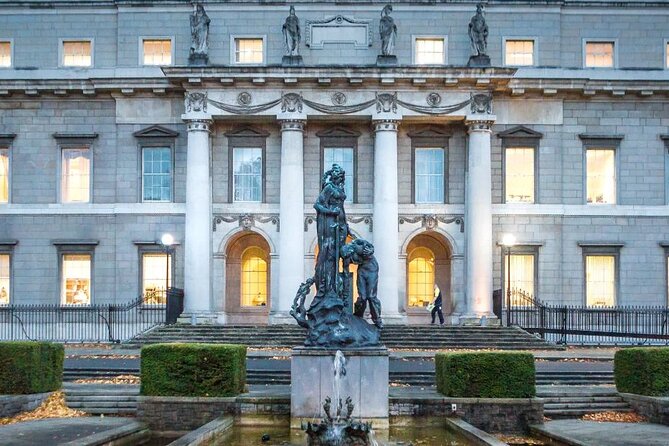
- See both memorials and working infrastructure, from the Famine Memorial and seafarers’ memorial to the sea lock and rolling lift bridges.
- Use the tour offline, with audio, maps, and geodata available without relying on mobile data.
- Expect a private experience for your group, with no fixed guide, departure time, or group pace.
- Allow 50 minutes to 1 hour 10 minutes, though pauses for photographs or extra sightseeing can affect your timing.
From the Custom House into Dublin’s old port
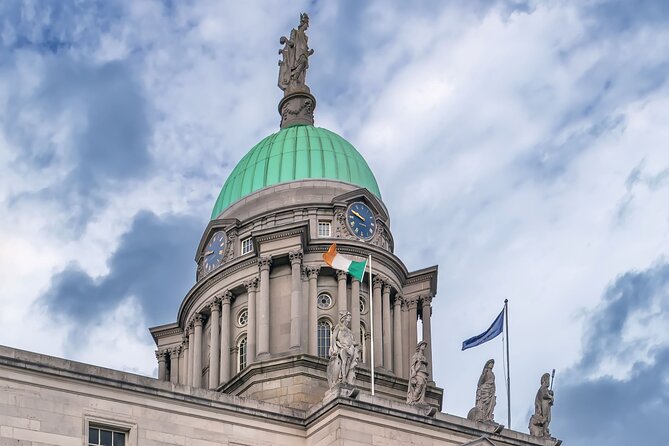
You begin at the Custom House on North Wall, Dublin 1. This neoclassical building once served as a center for Irish trade and commerce, making it a fitting starting point for a walk about shipping, business, migration, and city change.
The first section gives you a useful sense of place. Dublin’s Docklands was once closely tied to maritime work, warehouses, cargo, and river traffic. Today, the same district includes offices, transport links, apartments, cultural venues, and public spaces. The audio format helps connect these different layers as you walk.
The starting point is practical for most city visitors. It is close to Busáras, the Luas, city bus stops, and Tara Street DART station. You can also walk there in about 10 minutes from O’Connell Street or 15 to 20 minutes from College Green.
More Walking Tours in Dublin
- Dublin Highlights and Hidden Gems Guided Walking Tour
★ 5.0 · 6,020 reviews - Dublin: Highlights and Hidden Gems Walking Tour
★ 4.9 · 2,140 reviews - 1916 Rebellion Walking Tour
★ 5.0 · 1,605 reviews
Warehouses, workers, and transport links
From the Custom House, the route follows the quayside. Historic warehouses sit beside modern development, giving you a clear view of how the Docklands has changed over time. This is one of the strongest parts of the walk because you are not looking at isolated monuments. You are watching an entire district shift from port activity to a new urban role.
The route then brings you past a memorial to James Connolly. Connolly was an important figure in Ireland’s independence movement and in the fight for workers’ rights. His connection to the area adds a social and political dimension to the walk, beyond architecture and shipping.
You continue past Liberty Hall Theatre, a major landmark in Dublin’s labor history. The building links the Docklands with the city’s organized workers and political movements. I would pay close attention here, since it is easy to hurry past while focusing on the river.
Busáras comes next. Dublin’s central bus station is a busy transport hub, and its presence helps show how the district connects the city rather than simply serving as a waterfront promenade. You also pass Connolly Train Station, one of Dublin’s main railway stations, with domestic and international rail connections.
These stops are less scenic than the bridges and river views, but they make the route feel grounded in everyday Dublin. You are seeing a working part of the city, not just a collection of polished attractions.
The IFSC and the Docklands’ new identity
The walk passes the International Financial Services Centre, commonly called the IFSC. It is home to multinational companies and financial institutions, and it represents the Docklands’ newer economic role.
The contrast is sharp. Earlier stops focus on maritime trade, labor, and transport. Here, the story turns toward finance and international business. The audio guide is useful because the meaning of the buildings is not always obvious from the street. You can see modern offices, but the narration gives them a place in the wider story of Dublin’s economic development.
The route also includes the Triumphal Arch, a historic monument connected with Dublin’s maritime heritage and economic prosperity. It is a reminder that trade and shipping helped shape this part of the city long before the IFSC arrived.
Bridges and engineering along the Liffey
The Scherzer Rolling Lift Bridges offer one of the route’s more unusual sights. These engineering structures were built to allow maritime traffic through the docks. You may not spend long at them, but they show the practical machinery behind Dublin’s port life.
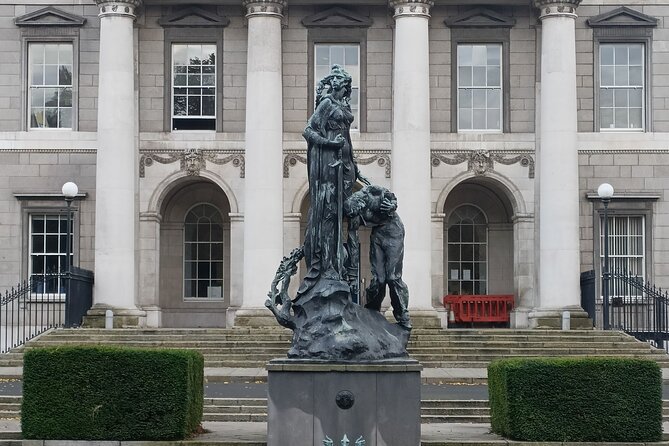
Next comes the Famine Memorial, one of the most moving stops on the walk. The memorial honors those who suffered during Ireland’s Great Famine in the 19th century. Its location near the river is especially fitting, since the quays were tied to emigration and departure.
You then cross the River Liffey on the Seán O’Casey Bridge. This is a good point to pause for views of the water, city buildings, and waterfront. The bridge gives you a physical change of scene, taking you from the older Custom House side toward the Grand Canal Dock area.
The route also passes a memorial to Irish seafarers who lost their lives at sea. Together, the Famine Memorial and seafarers’ memorial give this walk a serious emotional center. They remind you that the river was not only a source of commerce. It was also a route taken under hardship, danger, and loss.
A different sort of day from the same base:
- Dublin to Cliffs of Moher, including Wild Atlantic Way and Galway
★ 5.0 · 23,331 reviews - From Dublin: Cliffs of Moher, Burren & Galway City Day Tour
★ 4.8 · 18,888 reviews - Dublin: Guinness Storehouse Entry Ticket
★ 4.6 · 16,863 reviews - Dublin to Cliffs of Moher, Burren, Wild Atlantic Way, Galway Tour
★ 5.0 · 12,924 reviews
The Jeanie Johnston and stories of departure
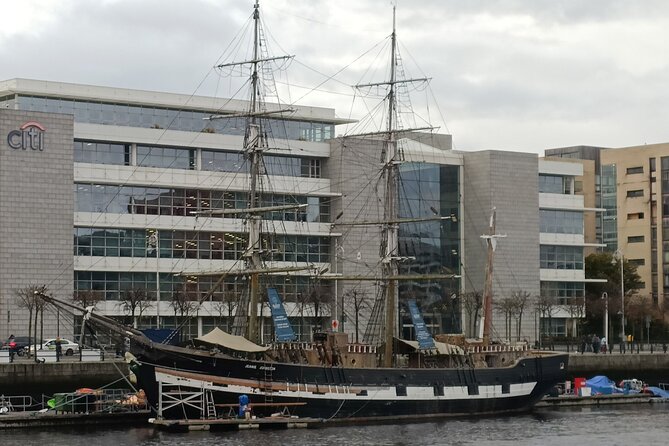
A replica of the Jeanie Johnston is one of the most recognizable sights on this section of the walk. The historic ship carried Irish emigrants to North America during the Great Famine.
You should expect the audio to place the ship within the larger story of movement through Dublin’s port. The stop works well after the Famine Memorial because it gives a physical form to the people who left Ireland by sea. Even if you only pause for a short look, the ship is an important part of the Docklands story.
This is also a good example of why the tour can be more useful than a simple map. A map can guide you to a ship, bridge, or memorial. The narration tells you why the sight belongs in this particular district and how it relates to the river.
Modern Dublin at Samuel Beckett Bridge
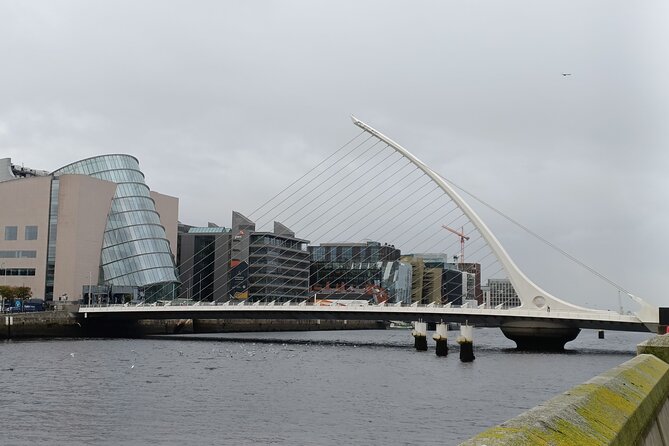
The Samuel Beckett Bridge is one of the Docklands’ best-known modern structures. It is named after the Irish writer and has become a strong visual marker on the Liffey.
The bridge changes the mood of the route. Earlier sights connect to port work, migration, and labor. Here, the focus moves toward modern design and Dublin’s cultural identity. The walk continues past the Convention Centre Dublin, a modern venue for conferences, events, and exhibitions.
This section is likely to appeal to anyone interested in the way Dublin combines old and new. The route does not treat the Docklands as a museum district. You pass active buildings, major transport links, public venues, and working water infrastructure alongside monuments and historic sites.
Admiral Brown, the Diving Bell, and the East-Link
The route passes a statue of Admiral William Brown, an Irish-born naval officer who founded the Argentine Navy. It is a less familiar detail than the Famine Memorial or Samuel Beckett Bridge, which makes the audio explanation particularly worthwhile.
You also see the historic Diving Bell. It was used for dock maintenance when Dublin’s port was a much more active maritime workplace. This is the sort of object that many people would miss without a prompt. It is not a grand monument, but it offers a glimpse into the technical work needed to maintain the docks.
The Tom Clarke Bridge, also called the East-Link Bridge, comes next. It provides an important connection between north and south Dublin. Its inclusion reinforces one of the tour’s central ideas: the Docklands is both a historic port and a major route through the modern city.
The path then passes BrewDog Outpost Dublin, a craft brewery with a lively setting. This stop shifts the tone again, from maritime history to present-day food, drink, and leisure. The tour does not include a drink or tasting, so consider this a landmark along the route rather than part of the booked experience.
Sea locks, canal history, and Hanover Quay
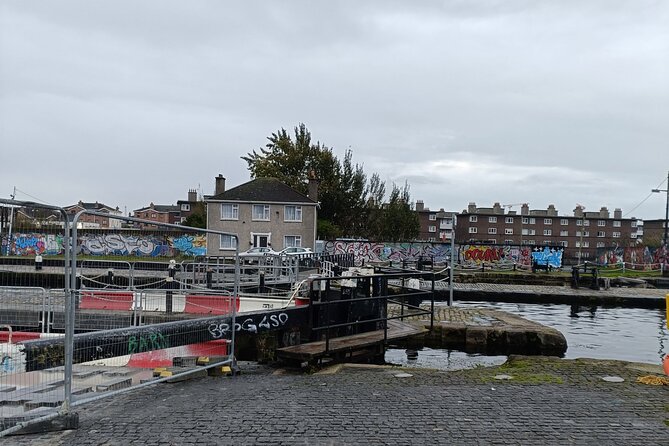
The sea lock is another practical piece of port infrastructure. It regulates water levels in the docks and helps explain how the area functions as a managed water system. Like the Diving Bell and rolling lift bridges, it rewards you for looking beyond the most famous sights.
The Grand Canal Docks sign marks the entrance to Dublin’s historic canal basin. This is where the route begins to feel more closely tied to the district’s newer public and residential spaces.
You then pass Hanover Quay, an area with a mix of homes and commercial buildings. The combination shows how former working dock areas can take on new uses. The tour gives you a way to notice that change without losing sight of the older port setting.
Hanover Quay Studios is another unusual stop. It is a recording studio complex used by musicians and artists. This detail broadens the story of the Docklands once again, connecting the area not only with business and transport but also with creative work.
Finishing at Grand Canal Square and Red Sticks Dublin
The walk ends at Grand Canal Square, a modern public space with contemporary architecture and cultural attractions. The square provides a clear finish after the river crossing, bridges, memorials, port structures, and newer buildings along Hanover Quay.
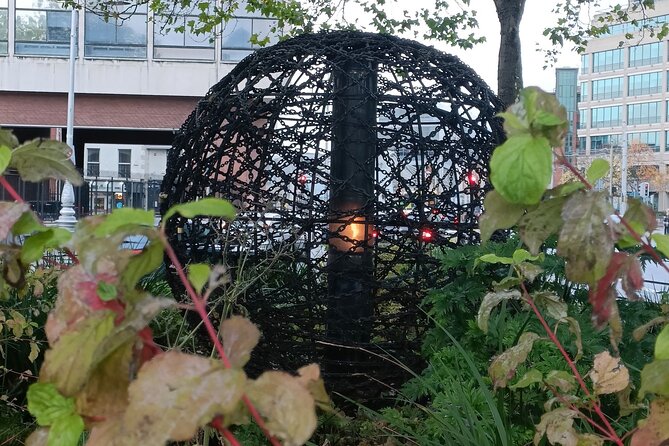
You also pass Red Sticks Dublin, a landmark sculpture that adds an artistic touch to the final part of the route. The stated end point is at Red Sticks Dublin on the Grand Canal.
The tour’s ending is convenient if you want to continue exploring the Grand Canal Dock area. It is also a sensible place to stop for a meal or drink, though those purchases are not included. Since the tour is self-guided, you can finish the audio and then decide how long you want to remain in the area.
How the audio and GPS format work for you
This is not a live walking tour. You use your own smartphone and headphones, and the GPS-guided format plays the relevant narration as you move through the route.
That setup gives you several advantages. You can pause when you want photographs, replay a section, or slow down for a memorial. You are not trying to keep up with a guide or wait for a large group.
The audio is offered in English, with narration from a local insider. A previous user described the guide as easy to understand and the pace as manageable, and that is useful information when deciding if this format suits you. The route is designed to take about 50 minutes to 1 hour 10 minutes, depending on your walking speed and stops.
You receive directions to the start point, plus offline access to the audio, maps, and geodata. You also get unlimited lifetime use, including the option to listen as an audiobook from somewhere other than the route. That makes the $11.99 price easier to justify if you want to review the history later or share the experience with your own group.
The tradeoff is simple: you handle the technology yourself. Bring a charged smartphone and headphones. If your battery is low or you dislike listening while walking, a live tour may suit you better, but no live guide is included here.
Who will get the most from this tour
I would recommend this walk to independent visitors who want historical context without committing to a long scheduled tour. It is also a good choice if you have already seen central Dublin and want to understand the Docklands, a district that can feel spread out and modern at first glance.
It suits:
- First-time visitors who want a compact introduction to Dublin’s riverfront.
- Repeat visitors looking for a different part of the city.
- History fans interested in trade, labor, famine, migration, and maritime work.
- Architecture fans who want to compare the Custom House, modern bridges, offices, and public buildings.
- Independent walkers who prefer stopping for photographs without a fixed group.
- Small private groups, since only your party takes part.
It may be less suitable if you want a personal conversation with a guide, a food stop, or a tour built around indoor attractions. The route is mainly an outdoor walk, and the experience depends on your phone, headphones, and willingness to follow the audio.
Is $11.99 a fair price?
At $11.99, this is inexpensive for a private, self-paced audio experience with lifetime access. You can also use the virtual playback option away from the route, which adds value if you want to hear the material again.
The route itself is free to walk, so you are paying for the narration, directions, GPS prompts, maps, and historical links between the sights. That is a fair exchange if you would otherwise pass the Diving Bell, seafarers’ memorial, rolling bridges, or Admiral Brown statue without knowing their significance.
The value is weaker if you already know Dublin’s Docklands well or plan only a quick look at the river. You also need to remember that the booking cannot be refunded or changed, so confirm your schedule before paying.
Practical details before you set out
The tour operates every day, with the listed opening period running from October 4, 2024, through February 16, 2027. Since it is self-guided, you are not tied to a particular departure time.
The start is near public transport, including Busáras, Luas and bus stops, and Tara Street DART station. Service animals are allowed, and most people can take part. Bring your own smartphone and headphones, and download or prepare the offline material before walking so you are not depending on a mobile connection.
The experience is private for your group. You can stop at any point, but keep the route length in mind if you have another appointment afterward.
Should you book the Dublin Docklands audio walk?
Book it if you want a low-cost, flexible way to understand Dublin’s riverfront, especially the links between maritime trade, famine emigration, labor history, modern finance, and new public spaces.
I particularly recommend it for independent visitors who value a manageable pace and want more than a list of landmarks. Skip it if you need a live guide, dislike using your phone while sightseeing, or cannot accept a non-refundable booking.
For $11.99, the tour offers a focused walk with enough variety to keep the Docklands interesting: grand buildings, bridges, memorials, ships, engineering works, transport hubs, and contemporary architecture. It is a practical choice for seeing this changing part of Dublin with a little more meaning.
FAQ
How long does the Dublin Docklands walking tour take?
The tour takes approximately 50 minutes to 1 hour 10 minutes.
Where does the tour begin?
It begins at the Custom House on North Wall, Dublin 1, County Dublin.
Where does the tour end?
It ends at Red Sticks Dublin on the Grand Canal, near Grand Canal Square.
What language is the audio tour offered in?
The audio tour is offered in English.
Do I need to bring my own phone and headphones?
Yes. A smartphone and headphones are not included, so you need to bring your own.
Can I use the maps and audio without mobile data?
Yes. The tour includes offline access to the audio, maps, and geodata.
Is this a private tour?
Yes. Only your group participates, and you can explore at your own pace using the GPS-guided audio.
More self-guided routes in Dublin
- Christ Church Cathedral Entrance Ticket & Self-Guided Tour
★ 4.6 · 773 reviews - Dublin Ghost Hunt Exploration Game and Tour
★ 4.0 · 34 reviews - Private Dublin Treasure Hunt Self Guided Tour
★ 4.5 · 14 reviews - Dublin Self-Guided Murder Mystery Tour by Temple Bar
★ 3.5 · 12 reviews
Recently added around Dublin
- Dublin: Pub Tour. Pour The Perfect Guinness, Whiskey & Music★ 5.0 · 3 reviews
- Waterford Crystal and Kilkenny Full-Day Rail Tour from Dublin★ 5.0 · 3 reviews
- Cliffs of Moher and The Burren Private Tour from Dublin★ 5.0 · 3 reviews
- Private Chauffeur Service From Dublin Airport to Killarney★ 5.0 · 3 reviews
- Beautiful Southwest Tour 2022★ 5.0 · 3 reviews
- Dublin One Day Tour with a Local: 100% Personalized & Private★ 4.5 · 3 reviews
- Ireland: 3-Day West Coast Explorer Tour★ 5.0 · 3 reviews
- Dublin Full-Day Tour through Boyne Valley★ 5.0 · 3 reviews
Dublin Tours, compared.

Dublin to Cliffs of Moher, including Wild Atlantic Way and Galway
Read our review →
Cliffs of Moher, Burren & Galway City Day Tour
Read our review →

Dublin to Belfast Black Cab, Dunluce Castle and Giant’s Causeway
Read our review →
Kilkenny, Wicklow Mountains & Glendalough Day Tour from Dublin
Read our review →
Wicklow Mountains, Glendalough & Kilkenny Tour
Read our review →

Dublin Highlights and Hidden Gems Guided Walking Tour
Read our review →Browse the lists this tour appears in