
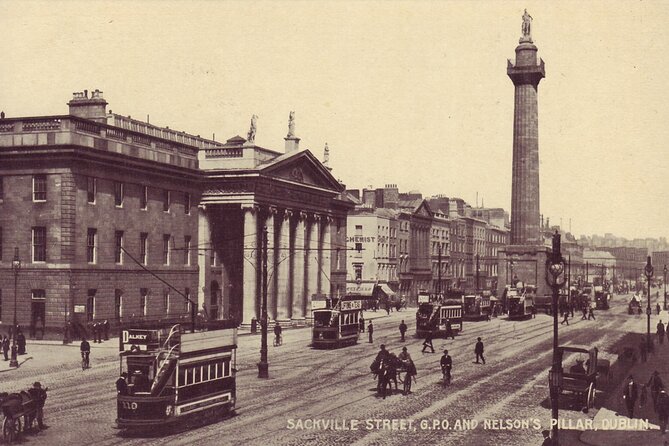
Reviewed · DUBLIN TOURS
2-Hour Historical Walking Tour from Dublin
Dublin’s past comes at you fast on this walk. In about two hours, you move from the Viking settlement and medieval cathedral to British rule, Irish independence, civil war, and modern political life. The tour is led by history postgraduates, including guides such as Jody, Eoin, John, and Caolan, so expect more than a quick look at handsome buildings.
I like the strong historical thread and the way each stop helps explain the next. I also like the small group size, capped at 25, which makes it easier to hear the guide and ask questions. The main caution is that this is a serious history lesson. Some guides cover a great deal of politics and dates, and the walk can run well beyond two hours.
Key points to know before booking
- Trinity College is the starting point: Meet at the Henry Grattan Monument on College Green, opposite the front gate, not at the gate itself.
- The Book of Kells is discussed, not included: You learn why the manuscript matters, but admission is not part of the tour.
- You get Dublin’s political story: The route connects British administration, Catholic emancipation, the 1922 Civil War, and Irish independence.
- The tour covers central Dublin efficiently: Trinity College, Temple Bar, Wood Quay, the Four Courts, Christ Church, City Hall, and Dublin Castle all fit into one walk.
- Expect an academic guide with a lively delivery: Jody, Eoin, John, and other guides bring postgraduate-level study, jokes, stories, and occasional songs to the route.
- Wear comfortable shoes and watch the forecast: The walk is not described as difficult, but it takes place outdoors and may last two and a half hours.
Why this tour works as a first look at Dublin
I like taking a city history walk early in a trip, and this one is built for that purpose. It gives you a working map of central Dublin while explaining why the city has English, Viking, medieval, Protestant, Catholic, and republican layers.
The price is about $22.98 per person. That is good value if you want a guide to connect the sights rather than simply point them out. You are not paying for entry to attractions, but the tour itself visits many important places from the outside and provides the context you need before exploring them independently.
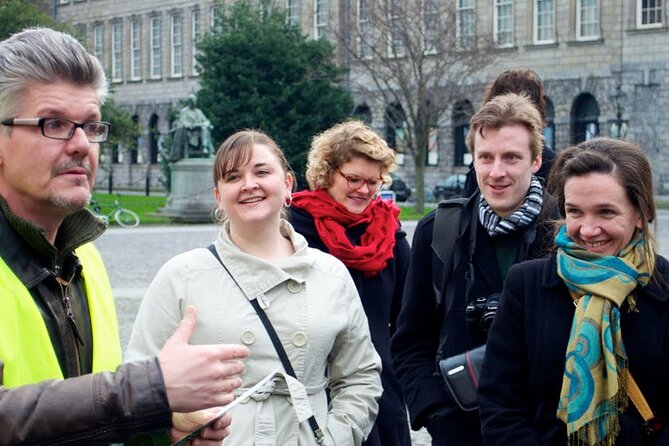
The group limit of 25 is also useful. This is not a private walk, so you will share the guide with other people, but the cap keeps it from becoming a large crowd. A clear voice matters here, especially at busy streets and open public spaces, and the guides are repeatedly praised for being easy to hear.
The tone depends on the guide. Jody is described as animated, passionate, and an excellent storyteller. Eoin is noted for his humor, clear explanations, and ability to keep the group engaged in poor weather. John brings a strong sense of humor and a broad overview. Caolan is among the newer guides and has been praised for making the material accessible.
More Historical Tours in Dublin
- Dublin Historical Centre Food Tour with 8 Food Tastings & Drinks
★ 5.0 · 1,718 reviews - Historical 2-Hour Guided Walking Tour of Dublin
★ 4.7 · 865 reviews - Dublin to Cork, Blarney Castle & Cóbh Heritage Centre by train
★ 4.5 · 510 reviews
Starting at Trinity College and the Book of Kells
The walk begins at the Henry Grattan Monument on College Green. This detail matters. The meeting point is opposite Trinity College’s front gate, not directly at the gate, and one person missed the tour after waiting in the wrong place. Check the exact point before setting off, and use the mobile contact attached to your booking if you have trouble finding the group.
Trinity College gives the guide an ideal opening. Founded in 1592, it is Ireland’s oldest university, and its long institutional life provides a neat way to begin discussing Dublin’s religious, political, and intellectual past.
The guide also explains the Book of Kells, an eighth-century manuscript containing the four Gospels in Latin. The manuscript is one of Ireland’s most famous objects, but admission is not included. That means this stop gives you the background, not the full exhibition visit.
I see that as a useful arrangement for a short walking tour. You can decide later if you want to pay separately to enter the Book of Kells display. If you already plan to visit it, the guide’s introduction should make the experience more meaningful. If illuminated manuscripts are not your priority, you still get the college’s history without spending part of the tour inside.
The allotted time here is about 20 minutes. That is enough for an outline and a few questions, not a full campus visit. The tour is designed to keep moving.
Bank of Ireland and the story of Protestant power
The next stop is the Bank of Ireland, a grand building that once housed Ireland’s colonial parliament. Built in 1729, it became a symbol of Protestant Ascendancy, the period when political and economic power rested heavily with the Protestant ruling class.
The building also gives the guide a chance to discuss the Act of Union of 1800, which abolished the Irish Parliament and tied Ireland more closely to Britain. The point is not simply architectural. The neoclassical style reflects the confidence and authority of the political order that commissioned it.
You spend about 10 minutes here. That sounds brief, but the guide uses the building as a visual anchor for a difficult subject. I appreciate this kind of stop because it turns an abstract political system into something you can see in front of you.
This is also where you should recognize the tour’s character. The focus is not only on pretty streets and famous names. The guide asks who held power, who was excluded, and how those arrangements shaped later Irish politics. If you prefer a light introduction centered on cafés, music, and local customs, this section may feel dense.
Temple Bar beyond the nightlife image
Temple Bar is now one of Dublin’s best-known districts, but the guide explains that it was once marked for demolition. In the 1990s, it was repurposed as Dublin’s Cultural Quarter.
That change says a lot about how cities remake themselves. Temple Bar is often presented as a ready-made entertainment district, but its current identity came from a planning decision and a change in how Dublin viewed its older central streets.
The stop lasts about 10 minutes. You will not spend the whole visit wandering through the lanes or stopping for a drink. Instead, you get the area’s urban story and then continue along the route.
This is one of the moments when the tour adds useful balance. The district is easy to reduce to pubs and crowds. The guide places it within Dublin’s changing city plans, giving you a better reason to look closely at the streets rather than simply pass through them.
More Walking Tours in Dublin
- Dublin Highlights and Hidden Gems Guided Walking Tour
★ 5.0 · 6,020 reviews - Dublin: Highlights and Hidden Gems Walking Tour
★ 4.9 · 2,140 reviews - 1916 Rebellion Walking Tour
★ 5.0 · 1,605 reviews - 90 Minute Dublin Walking tour and Sightseeing tips
★ 5.0 · 916 reviews
Wood Quay and Dublin’s Viking beginnings
At the Wood Quay Amphitheatre, the subject shifts back to the city’s earliest recorded urban roots. Extensive archaeological work in the 1980s uncovered evidence connected with the Viking city founded around AD 840.
This stop helps correct a common misunderstanding. Dublin is not simply an English medieval creation. Viking settlement was central to the city’s early development, and the archaeological discoveries at Wood Quay revealed how much of that past had been preserved beneath the modern city.
You spend about 10 minutes here. The amphitheatre is not a museum visit, so the value comes from the explanation. Pay attention to how the guide links the site to the growth of Dublin as a port and settlement.
I find this kind of short stop especially helpful for building a mental timeline. Trinity College represents a later intellectual institution, the Bank of Ireland points to eighteenth-century power, and Wood Quay takes you back to the city’s Viking foundation. The route keeps changing period without losing its central focus.
The Four Courts and the 1922 Civil War
The Four Courts is Ireland’s legal headquarters and one of the most politically charged stops. It was the site where a Civil War began in June 1922, after divisions opened between those who supported the Treaty of December 1921 and those who opposed it.
That Treaty had brought the War of Independence, fought from 1919 to 1921, to an end. The argument over the Treaty split the independence movement, and the Four Courts became a major setting in the conflict that followed.
The stop receives about 20 minutes, one of the longer pauses on the walk. That makes sense. You need some time to understand the difference between ending a war and agreeing on the future of the country.
The guide may spend more time on political detail here than you expect from a sightseeing walk. This is the section most likely to test your attention, especially if you are not used to Irish political names and competing factions. Still, it is one of the most valuable parts of the route because it explains why the struggle for independence did not end neatly in 1921.
The walk itself is not described as strenuous, but it is a full city walk with extended periods on your feet. One useful approach is to treat this as a moving classroom. Listen for the broad chain of cause and effect rather than trying to memorize every person and date.
Christ Church Cathedral and the medieval invasion
Christ Church Cathedral is identified as Dublin’s oldest cathedral, founded in 1030. It was rebuilt in stone in the 1170s by Strongbow, the Anglo-Norman leader closely tied to the original English invasion of that period.
This stop brings medieval Dublin into the story and shows how religious buildings can also be political markers. The cathedral’s age reaches back before the later English state, while its rebuilding connects to the arrival of new ruling powers.
The visit here lasts about 10 minutes. As with the other stops, this is an exterior historical explanation rather than a cathedral admission. If you want to explore inside, you will need to make a separate plan.
Christ Church is also a useful orientation point. The tour’s listed endpoint is at Christ Church Cathedral on Christchurch Place, even though the historical route continues through nearby City Hall and Dublin Castle in the stated sequence. Confirm the day’s precise finish with your guide, particularly if you have a timed booking afterward.
City Hall and Daniel O’Connell
Inside City Hall is a statue of Daniel O’Connell, Dublin’s first Catholic Lord Mayor, elected in 1840. O’Connell led the successful campaign for Catholic Emancipation in 1829, ending anti-Catholic laws that had restricted the rights of Catholics.
The guide uses O’Connell to explain a major shift in Irish public life. His title, The Liberator, reflects the importance of that campaign and the force of his political organizing.
You spend around 10 minutes at City Hall. This is a compact stop, but it gives the route a strong human figure. After discussing institutions such as the old Parliament and the Four Courts, you meet a politician whose work changed who could take part in civic life.
If you enjoy biographies, this section should hold your attention. If you want more time inside historic buildings, the short schedule may disappoint. The tour’s purpose is to connect several places, not provide long indoor visits.
Dublin Castle and the city’s Black Pool
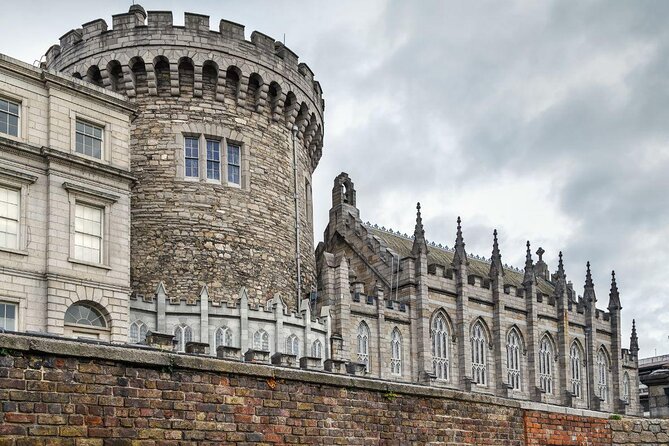
Dublin Castle was originally built by King John in 1204 and served as the center of British administration until 1922. It is also connected with the Dubh Linn, or Black Pool, from which Dublin takes its name.
That makes the castle a fitting final historical anchor. It links the city’s name, medieval authority, and the British administrative period to the political changes that created the modern Irish state.
The guide’s explanation should help you see the castle as more than a formal courtyard and government building. Its importance lies in the power it represented. The end of British administration in 1922 gives the earlier stops at the Four Courts and City Hall added weight.
The visit lasts roughly 10 minutes. You are not paying for a castle entry, and the walk does not promise a full interior tour. Plan another visit if you want to see the rooms and exhibitions at length.
How much history fits into two hours
The tour’s advertised length is about two hours, but you should allow some flexibility. One group finished closer to two and a half hours, while another found the walk comfortably paced. The difference may depend on the guide, questions, group size, and weather.
Several guides use a quick overview at the start, then add detail at each stop. Eoin was described as giving an easy-to-follow outline of roughly 5,000 years in a few minutes before building on it along the route. That method is helpful because Irish history can otherwise feel like a long list of names and uprisings.
You need to listen closely. The material reaches from Celtic settlement and Viking Dublin through medieval invasion, Protestant political control, Catholic emancipation, the War of Independence, the Civil War, and recent political developments including Brexit.
The strongest guides make that sequence feel connected. They add humor, small stories, and sometimes songs without losing the main thread. Jody, in particular, is noted for combining serious historical knowledge with an animated delivery and theatrical skill.
Still, do not book this expecting a casual stroll. One person found the political detail too dense and the tour too long. That criticism is fair as a warning, even though the guide was also described as passionate and skilled. You should be comfortable giving sustained attention while walking.
Practical details that affect your day
The tour is offered in English and uses a mobile ticket. It is near public transportation, and service animals are allowed. A moderate level of physical fitness is advised, which mainly means being ready to walk and remain standing through several outdoor stops.
Dublin weather can change your experience. January cold, wind, and rain have not prevented guides from delivering the walk, but you will enjoy it more with sensible clothing and comfortable shoes. Bring an umbrella or rain layer and allow extra time if wet streets slow you down.
The group can include up to 25 people. That is large enough for a social group experience but small enough for the guide to maintain a clear flow. The guide’s voice and your position in the group matter, so move closer when a stop becomes crowded.
The experience is booked an average of 21 days ahead. That does not guarantee that every departure sells out, but it is a good reason to reserve early if you want a particular day or time, especially at the start of your stay.
Free cancellation is available up to 24 hours before the start time. Changes or cancellations inside that window are not accepted for a refund.
Who will get the most from this walk
I would choose this tour if you want historical context before visiting Dublin’s museums and landmarks on your own. It is particularly useful for first-time visitors who want to understand why the city’s major buildings matter.
It suits:
- History fans who enjoy political detail and long timelines
- First-time visitors who want to get oriented quickly
- Adults and older teenagers who can follow sustained discussion
- People who prefer a small group to a private guide’s higher price
- Anyone planning to visit Trinity College, Dublin Castle, or the Four Courts independently
I would be more cautious if you are traveling with young children who need frequent activity changes. The amount of political and constitutional history may also be too much if you want a relaxed culture walk with only a few historical facts.
At $22.98, I think the value is strongest when you use the walk as a foundation for the rest of your Dublin stay. You get no paid admissions, but you do get a guide with postgraduate training, a carefully linked route, and an efficient introduction to central Dublin.
Should you book the Dublin historical walking tour?
Book it if you want Dublin explained rather than merely shown. The best part is the connection between places: Viking settlement at Wood Quay, medieval power at Christ Church, Protestant government at the Bank of Ireland, political conflict at the Four Courts, and British administration at Dublin Castle.
Schedule it near the beginning of your trip so you can return to the buildings and areas that catch your interest. Just meet at the Grattan Monument, not the Trinity College gates, and allow more than two hours in case the guide’s explanations and questions extend the walk.
Skip it if you want a short, light sightseeing loop or if political history quickly loses you. For everyone else, this is a low-cost way to get the story behind Dublin’s center, delivered by guides who clearly care about the subject.
FAQ
How long does the tour last?
The tour is planned for approximately two hours. You should allow extra time because some departures have lasted about two and a half hours.
Where does the tour begin?
It begins at the Henry Grattan Monument on College Green, opposite the front gate of Trinity College Dublin.
Where does the tour finish?
The stated endpoint is Christ Church Cathedral on Christchurch Place, Dublin.
Is admission to the Book of Kells included?
No. The guide explains the history and importance of the Book of Kells, but entry is not included in the tour price.
How many people can join the tour?
The maximum group size is 25 travelers.
Is the tour offered in English?
Yes. The tour is offered in English.
What happens if I need to cancel?
You can receive a full refund if you cancel at least 24 hours before the experience start time. Cancellations or changes made less than 24 hours before the start time are not accepted for a refund.
More 2-Hour Experiences in Dublin
- 2 Hour Walking Tour of Dublin’s City Centre
★ 5.0 · 63 reviews - Dublin: 2-Hour Premium Whiskey and Food Tasting Tour
★ 4.7 · 54 reviews - Dublin: 2 Hour City Center Guided Walking Tour
★ 4.9 · 12 reviews - 2-Hour Deluxe Whiskey & Food Tasting
★ 4.6 · 9 reviews
More day trips out of Dublin
- From Dublin: Cliffs of Moher, Burren & Galway City Day Tour
★ 4.8 · 18,888 reviews - Kilkenny, Wicklow Mountains & Glendalough Day Tour from Dublin
★ 5.0 · 7,897 reviews - From Dublin: Wicklow Mountains, Glendalough & Kilkenny Tour
★ 4.8 · 6,235 reviews - Cliffs of Moher, Burren and Galway Day Tour from Dublin
★ 4.5 · 2,755 reviews
Recently added around Dublin
- Dublin: Pub Tour. Pour The Perfect Guinness, Whiskey & Music★ 5.0 · 3 reviews
- Waterford Crystal and Kilkenny Full-Day Rail Tour from Dublin★ 5.0 · 3 reviews
- Cliffs of Moher and The Burren Private Tour from Dublin★ 5.0 · 3 reviews
- Private Chauffeur Service From Dublin Airport to Killarney★ 5.0 · 3 reviews
- Beautiful Southwest Tour 2022★ 5.0 · 3 reviews
- A Self Guided Walking Tour of Dublin’s Docklands★ 4.5 · 3 reviews
- Dublin One Day Tour with a Local: 100% Personalized & Private★ 4.5 · 3 reviews
- Ireland: 3-Day West Coast Explorer Tour★ 5.0 · 3 reviews
Dublin Tours, compared.

Dublin to Cliffs of Moher, including Wild Atlantic Way and Galway
Read our review →
Cliffs of Moher, Burren & Galway City Day Tour
Read our review →
Dublin to Belfast Black Cab, Dunluce Castle and Giant’s Causeway
Read our review →
Kilkenny, Wicklow Mountains & Glendalough Day Tour from Dublin
Read our review →
Wicklow Mountains, Glendalough & Kilkenny Tour
Read our review →
Dublin Highlights and Hidden Gems Guided Walking Tour
Read our review →Browse the lists this tour appears in