
Reviewed · DUBLIN TOURS
Small Group-Dublin Walking Tours
Dublin’s story comes together nicely on this two-hour city walk, which links Viking origins, medieval churches, rebellion sites, Georgian streets, and modern café life. Guide Damian McGrath adds music, humor, and occasional skits, so this is more than a march past monuments.
I like the small group cap of eight, which makes questions and personal detours possible. I also like the route’s useful shape: it starts at Dublin Castle and ends near Grafton Street, giving you a practical map of central Dublin for the rest of your stay.
The main consideration is pace. You cover a lot of ground in two hours, often on cobblestones, and most stops are brief. You see the outside of many sights rather than touring their interiors, so this works best as an introduction, not a substitute for a full castle, cathedral, or Book of Kells visit.
Key points to know before booking
- Damian McGrath leads the walk with music and storytelling, tailoring some musical moments to the group.
- The route links ten central stops, from Chester Beatty and Dublin Castle to St Stephen’s Green and Powerscourt Townhouse.
- The group is capped at eight people, a real advantage for questions and a more relaxed exchange with the guide.
- Most sights are viewed from outside, with no admission fees included or needed during the walk.
- The tour is especially useful on your first day, since it gives you an overview of Dublin’s center and helps you choose where to return.
- Wear supportive shoes, because the route includes cobblestones and a fair amount of walking.
Dublin Castle and the city’s Viking beginnings
Meet at the Chester Beatty Library, in the Dubh Linn Garden behind Dublin Castle. This is an easy starting point in central Dublin, and the garden gives the opening minutes a calmer feel than the streets nearby.
Damian outlines the walk here, then uses the castle grounds to explain where Dublin got its name. The old setting of the dark pool, or Dubh Linn, helps connect the city’s present name with the water and settlement that shaped its beginnings.
You do not enter the Chester Beatty Library or Dublin Castle as part of this experience. That is worth knowing if you want a full interior visit. Instead, the value is orientation: you get the setting, the broad story, and a sense of how Dublin grew around this spot.
The castle stop lasts about ten minutes, but the subject reaches far beyond the walls. You begin with Dublin before its polished shopping streets and pub district, then move into the medieval center. For a first visit, that early context makes the rest of the walk easier to place.
More Small Group Tours in Dublin
- Dublin to Powerscourt, Wicklow and Glendalough Small Group Tours
★ 4.5 · 774 reviews - Dublin to Wicklow, Glendalough Small Group Tour with Horse Riding
★ 4.5 · 522 reviews - Dublin to Newgrange, Monasterboice Small Group Guided Tours
★ 4.5 · 500 reviews
Christ Church Cathedral and medieval Dublin
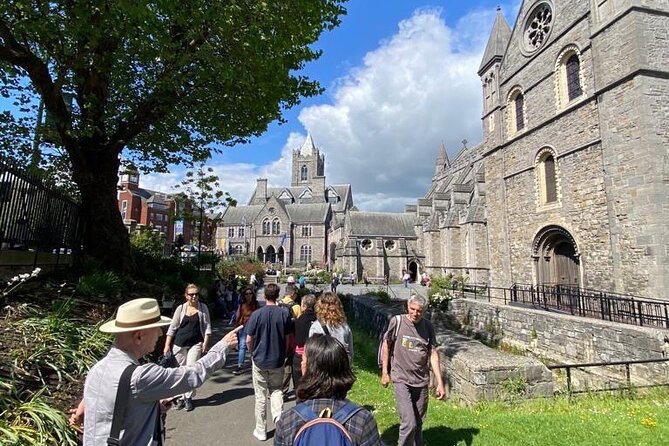
The next stop brings you past Christ Church Cathedral. The guide discusses the Catholic Church in Ireland and points out the venue connected with the first performance of Handel’s Messiah.
This is a good example of the tour’s broad reach. In a few minutes, you move from church history to music history and then back to the city’s Viking origins. The walk does not linger inside the cathedral, so anyone wanting architecture, tombs, or a longer look at the interior should plan a separate visit.
The short stop also sets up a useful question: Dublin is not one historical period. Viking settlement, medieval religion, British rule, Irish politics, literature, and modern city life all sit close together. Damian’s approach appears designed to connect those layers rather than treat each building as an isolated fact.
Temple Bar, the Ha’penny Bridge, and the River Liffey
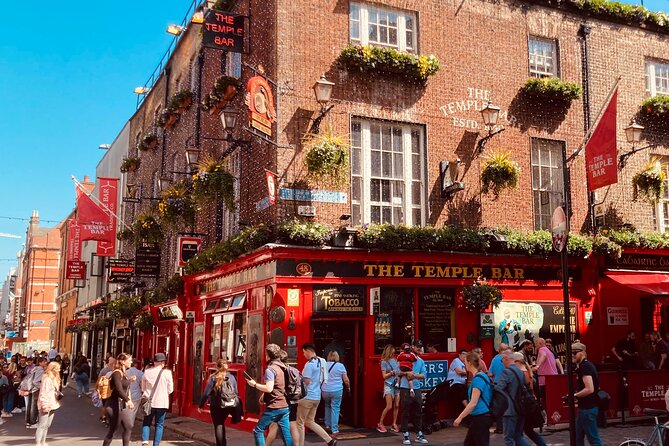
Temple Bar is the liveliest part of the route. You pass through Dublin’s famous nightlife quarter, with its pubs, music, and heavy foot traffic. It is the place many people picture when they think of an evening in Dublin, but seeing it during a daytime walk gives you a better sense of the neighborhood beyond its drinking reputation.
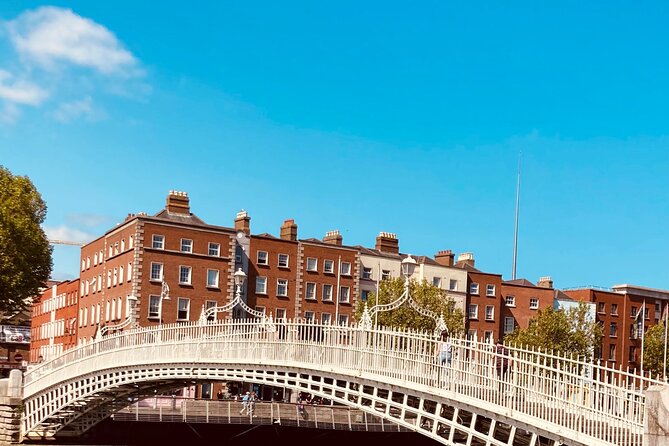
This is also where the route crosses the picturesque Ha’penny Bridge. The guide talks about trade, travel, and the foundations of the city as you move toward the River Liffey.
The bridge is a natural pause for photographs, though it can feel crowded. Temple Bar can also be noisy and packed, especially at busy times. The upside is that Damian can explain how the area fits into Dublin’s wider story, rather than leaving you with only its pubs and souvenir shops.
You get about fifteen minutes for this section. That is enough to take in the character of the area, cross the bridge, and ask questions, but not enough for a pub stop or a detailed neighborhood tour. Save your pint for later.
O’Connell Bridge and the story of 1916
At O’Connell Bridge, the walk shifts toward modern Irish political history. You see the statue of Daniel O’Connell, the Irish parliamentarian whose name is attached to the bridge, and hear about the River Liffey and the famous Liffey Swim.
The route is approaching the center of the events connected with the 1916 Easter Rising. This gives the walk an important change of tone. The earlier stops focus on origins, churches, and trade. Here, the guide begins to place Dublin’s streets within the struggle that helped shape the modern Irish state.
The stop lasts roughly ten minutes. You are not entering a museum or spending an hour on the rebellion, but you get a street-level introduction to the people and places involved. If Irish political history is a major interest, use this overview to decide if you want a longer visit to sites such as the General Post Office later in your stay. The route itself does not list the GPO as a stop.
More Walking Tours in Dublin
- Dublin Highlights and Hidden Gems Guided Walking Tour
★ 5.0 · 6,020 reviews - Dublin: Highlights and Hidden Gems Walking Tour
★ 4.9 · 2,140 reviews - 1916 Rebellion Walking Tour
★ 5.0 · 1,605 reviews - 90 Minute Dublin Walking tour and Sightseeing tips
★ 5.0 · 916 reviews
Trinity College and Parliament House
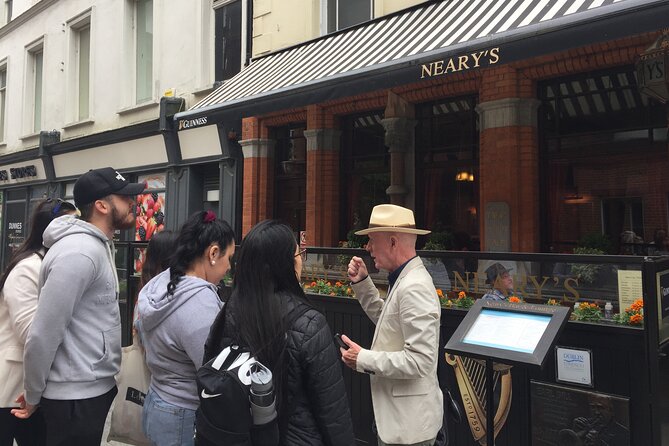
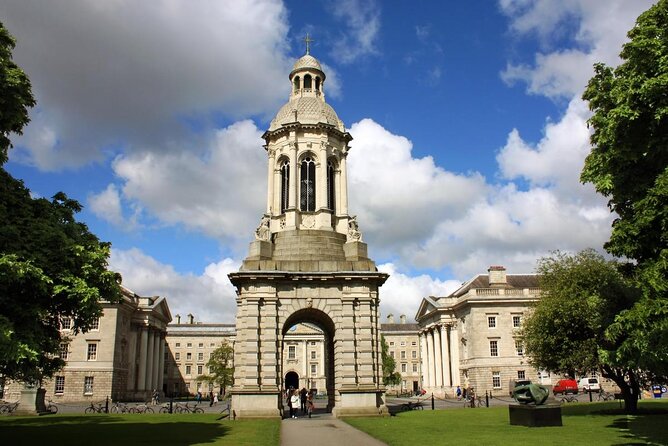
Trinity College brings you into the heart of Dublin’s academic and civic center. You can enter the university courtyard for a few minutes and look at its original architecture. Damian also discusses famous historical figures who studied there.
This is one of the more satisfying pauses because it gives you a chance to step inside a major institution, even briefly. The visit is not a Book of Kells tour, and admission to the famous manuscript display is not part of this walk. If that is on your Dublin list, you will need a separate ticket and more time.
The guide also points out the historic House of Lords, often called Parliament House, along Dame Street. These nearby buildings help explain how education, government, and public life developed in the same compact center.
The stop is only about ten minutes, so expect an introduction rather than a full lecture. That restraint suits the tour’s purpose. You get enough background to make a later Trinity visit more meaningful, without spending the whole afternoon in one place.
St Anne’s Church and Bram Stoker’s Dublin
At St Anne’s Church on Dawson Street, Damian talks about Bram Stoker’s wedding. The stop adds a literary angle to the walk and links one of Ireland’s best-known writers with an actual Dublin location.
From there, the route moves toward Bewley’s Café on Grafton Street. The café is a notable landmark, while Grafton Street provides a look at Dublin’s main high-end shopping district. This part of the route feels more like present-day city life, with shops, cafés, and street activity layered over older buildings.
The guide’s use of music seems particularly suited to this stretch. Musical interludes and short skits are a recurring part of the experience, and Damian adjusts some of them to the people in the group. That can make the walk memorable for families and for anyone who prefers stories and performance to a string of dates.
The tradeoff is that this style will not appeal to every visitor. If you want a quiet, formal lecture, music and theatrical moments may feel like a distraction. If you enjoy a guide who performs a little and responds to the group, it adds warmth without requiring a separate entertainment stop.
Leinster House, Stoker’s home, and the National Museum
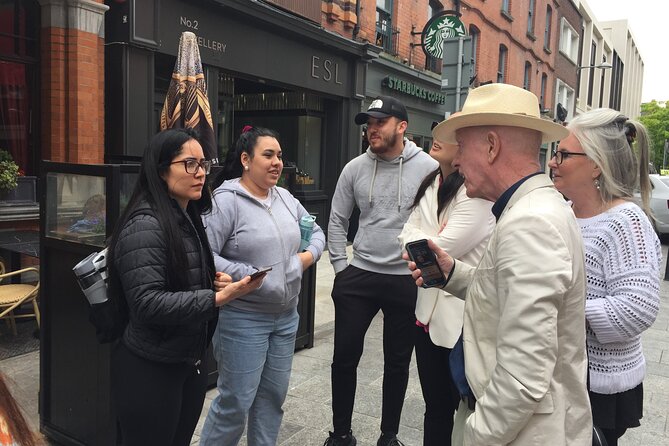
Kildare Street brings several useful sights into a short section. You pass the original home of Bram Stoker, see Leinster House, and learn about the building’s connection to the White House in Washington, DC. The route also passes the National Museum of Archaeology.
This is a strong stretch for understanding Dublin’s civic identity. Leinster House is not just an attractive government building. Its history and architectural relationship with Washington give Damian a way to connect Irish political life with a place many visitors already recognize.
You will view these places from the street. The National Museum of Archaeology is not an included museum visit, but its location makes it easy to mark for later. If you like archaeology, goldwork, Viking material, or prehistoric Ireland, this is one of the clearest follow-up suggestions on the route.
The walk does not try to cram every fact into the stop. Instead, it gives you several useful pins on your mental map. That is one reason this experience makes sense early in a Dublin visit.
St Stephen’s Green and the Royal College of Surgeons
The route continues along Grafton Street and toward St Stephen’s Green. You pass the Royal College of Surgeons, see Georgian-era architecture, and reach the compact city park.
This section offers a welcome change from dense streets. St Stephen’s Green gives you a little breathing room, while the Georgian buildings show Dublin at its most orderly and elegant. The Royal College of Surgeons adds another layer, this time tied to medicine and education.
The stop lasts about fifteen minutes, among the longer pauses on the walk. You still will not have time for an extended park visit, but you can take in the setting and note places to revisit. Grafton Street is also useful for practical orientation. You will know where to return for shopping, cafés, and a walk through the central retail district.
Because the route crosses so many busy areas, the park section may be one of the most pleasant parts of the morning or afternoon. It is also a reminder to keep your eyes up. Dublin’s character often appears in doorways, façades, and small public spaces between the headline attractions.
Powerscourt Townhouse and the end of the route
The final stop is Powerscourt Townhouse Centre on South William Street, between South William Street and Clarendon Street. The building is an architectural highlight, and its atrium now holds boutique shops, cafés, and restaurants.
Ending here is practical. You are close to Grafton Street, St Stephen’s Green, and several central dining areas, so you can continue exploring without retracing the route. It is a useful place to stop for lunch, coffee, or a look around after the guide leaves.
The tour ends at Powerscourt Townhouse rather than returning you to Dublin Castle. That one-way design saves time, but you should plan your next move. The start and finish are both central, though they are not the same place.
What the two-hour format really gives you
The advertised duration is about two hours, and the listed stops add up to roughly one hundred minutes. The remaining time is used for walking between them, questions, transitions, and the guide’s commentary.
That makes the schedule fairly active. You are not spending twenty minutes at every building. Instead, you receive a fast, coherent introduction to central Dublin, with enough pauses to take photographs and listen.
I would book this near the start of your stay. Several people found it useful for getting their bearings, and the route helps you decide which places deserve a longer return visit. It can also work well during a short Dublin stopover, since it covers major themes without taking an entire day.
The pace seems manageable for most people, but you should still wear comfortable shoes. Cobblestones and city pavements can be tiring, and the walk includes bridges, busy streets, and frequent movement. One participant with a hip problem appreciated Damian’s consideration, but the published information still says most people should be able to take part, not that the route is fully step-free or suitable for every mobility need.
Why the small group matters
A maximum of eight people changes the feel of a walking tour. You can ask about a building, a family connection, Irish writers, music, or food without trying to catch a guide’s attention across a large crowd.
The small size also helps with customization. Damian has adjusted the tour around timing and interests, and one family with children aged eleven and thirteen found the pace comfortable and the format engaging. That does not guarantee the same experience for every child, but the music and skits give younger participants something to follow besides dates and architecture.
Damian’s style is central here. He is described as friendly, engaging, and considerate, with a clear interest in telling the stories behind buildings. Music is tailored to the people on the walk when possible, and bystanders may hear and enjoy parts of it too.
That performance element is a strength for many people, but it is worth considering before you book. You are choosing a personal, entertaining guide rather than a strictly academic presentation. The historical content remains central, but it arrives through conversation, humor, music, and short theatrical touches.
Price, timing, and practical value
At $60.47 per person, this is not the cheapest way to walk around central Dublin. You can pass many of these streets for free on your own. The value comes from having the route organized, the city explained in context, and a local guide available for questions.
There are no paid admissions included in the stops. You are paying for Damian’s time, preparation, storytelling, and the small group setting. That is reasonable if you want a human introduction to Dublin and prefer not to spend half a day inside one attraction.
The price is less compelling if you already know central Dublin or plan to visit every site independently with a guidebook. In that case, the brief exterior stops may not add enough. For a first visit, though, the combination of orientation and personality makes the cost easier to justify.
This experience is often booked well ahead, with an average booking lead time of sixty-six days. That suggests you should reserve early if your dates are fixed, especially since the group is capped at eight. Confirmation arrives at booking, and free cancellation is available up to twenty-four hours before the start time. A cancellation within that final twenty-four-hour window is not refunded.
The tour is offered in English. It is near public transportation, service animals are allowed, and the provider says most people can participate.
Who should book this Dublin walk
I would choose this tour if you want a first-day overview with a guide who brings personality to the streets. It suits couples, families, solo visitors, and small groups who enjoy asking questions and moving at a steady city pace.
It is especially helpful if you want to connect famous sights with less obvious details, such as Bram Stoker’s wedding church, the former home of Stoker, the link between Leinster House and the White House, or the story behind Dublin’s name.
Families may appreciate the music and skits, while history-minded visitors will like the range from Viking settlement to the 1916 Rising. The walk also suits anyone with only a few hours in Dublin who wants a quick sense of how the center fits together.
I would look elsewhere if you want extensive interior visits, a slow photography walk, or a specialist tour focused on one subject. You will see many landmarks, but most are short exterior stops. This is a lively introduction, not an all-day historical seminar.
FAQ
How long does the Dublin walking tour last?
The tour lasts approximately two hours.
Where does the tour begin?
It begins at the Chester Beatty Library in the Dubh Linn Garden behind Dublin Castle, at Castle Street in Dublin 2.
Where does the tour end?
The walk ends at Powerscourt Townhouse Centre on South William Street, between South William Street and Clarendon Street.
How many people can join the tour?
The group has a maximum of eight participants.
Is the tour offered in English?
Yes. The tour is offered in English.
Can I cancel for a full refund?
Yes, if you cancel at least twenty-four hours before the experience start time. Cancellations or changes made less than twenty-four hours before the start are not accepted for a refund.
Should you book Small Group Dublin Walking Tours?
Book it if you want to get your bearings quickly, hear Dublin explained by a personable local guide, and cover the central sights without giving up an entire day. Damian McGrath’s music, skits, and flexible approach add something you will not get from simply following a map.
Go in with the right expectation: you will see many places from outside, spend only a few minutes at most stops, and walk at a steady pace. Wear good shoes, book it near the start of your stay, and use the route to choose where you want to return. For a first look at Dublin’s center, the small group and lively storytelling make the $60.47 price a fair trade for two well-used hours.
Recently added around Dublin
- Dublin: Pub Tour. Pour The Perfect Guinness, Whiskey & Music★ 5.0 · 3 reviews
- Waterford Crystal and Kilkenny Full-Day Rail Tour from Dublin★ 5.0 · 3 reviews
- Cliffs of Moher and The Burren Private Tour from Dublin★ 5.0 · 3 reviews
- Private Chauffeur Service From Dublin Airport to Killarney★ 5.0 · 3 reviews
- Beautiful Southwest Tour 2022★ 5.0 · 3 reviews
- A Self Guided Walking Tour of Dublin’s Docklands★ 4.5 · 3 reviews
- Dublin One Day Tour with a Local: 100% Personalized & Private★ 4.5 · 3 reviews
- Ireland: 3-Day West Coast Explorer Tour★ 5.0 · 3 reviews
Dublin Tours, compared.

Dublin to Cliffs of Moher, including Wild Atlantic Way and Galway
Read our review →
Cliffs of Moher, Burren & Galway City Day Tour
Read our review →

Dublin to Belfast Black Cab, Dunluce Castle and Giant’s Causeway
Read our review →
Kilkenny, Wicklow Mountains & Glendalough Day Tour from Dublin
Read our review →
Wicklow Mountains, Glendalough & Kilkenny Tour
Read our review →

Dublin Highlights and Hidden Gems Guided Walking Tour
Read our review →Browse the lists this tour appears in