
Reviewed · DUBLIN TOURS
Small Group Bucket List Sights Walking Tour with a Local Guide
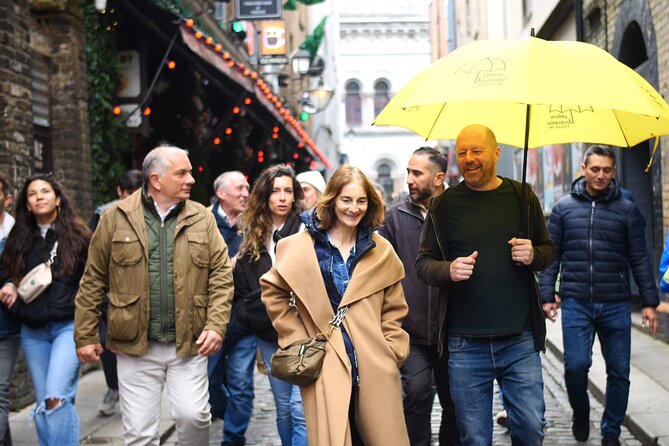
Dublin’s best first look may be on foot, and this two-hour route packs the city center’s big names into one sensible walk. You move from Christ Church Cathedral and St. Patrick’s Cathedral across Dublin Castle, Temple Bar, the River Liffey, College Green, and Trinity College. Peter, Patrick, Rob, and Martin are among the guides who lead it, with a strong focus on history, local detail, and questions.
I like the way the tour connects buildings to Ireland’s political story, rather than treating each sight as a separate photo stop. I also like the practical advice woven into the walk, especially suggestions for museums and other things to do after the tour. The main drawback is clear: you do not enter the major paid attractions, and a maximum group of 25 can feel less personal than the phrase small group suggests.
Key points to know before you book
- Twelve central Dublin sights: The route covers the city’s major historic landmarks without requiring buses or taxis between stops.
- A useful first-day orientation: You finish near Trinity College, in a good position to continue exploring on your own.
- Strong guide-led storytelling: Peter is frequently named, while Patrick, Rob, and Martin also lead tours, each adding history and local suggestions.
- No attraction admission included: The cathedral interiors, Dublin Castle, and Book of Kells exhibition require separate entry if you choose to visit.
- About two hours at $20.52: The price is modest for a guided introduction, especially if you use the route to plan the rest of your Dublin stay.
- Maximum group of 25: Most people can participate, service animals are allowed, and the meeting point is near public transportation.
Why this route works as a first look at Dublin
The clever part of this tour is its route. It begins at Wood Quay, near the old heart of Dublin, then traces a broad arc through the medieval center, across the Liffey, and back toward College Green. You are not spending the full two hours in one district. Instead, you get a quick sense of how Dublin grew from a Viking settlement into a religious center, a seat of British government, a modern capital, and a city known for pubs, literature, and technology.
I find that useful because Dublin’s center is compact but not always easy to read at first. A guide gives the streets an order. You learn which landmarks deserve an inside visit, where the political center once sat, and how the north and south sides of the river fit together.
The pace is designed as a whistle-stop tour, not a slow architectural study. Each listed stop is allotted about ten minutes, though the actual rhythm depends on questions and group size. That keeps the walk moving, but you should not expect long time for photographs, quiet reflection, or detailed interior visits.
More Small Group Tours in Dublin
- Dublin to Powerscourt, Wicklow and Glendalough Small Group Tours
★ 4.5 · 774 reviews - Dublin to Wicklow, Glendalough Small Group Tour with Horse Riding
★ 4.5 · 522 reviews - Dublin to Newgrange, Monasterboice Small Group Guided Tours
★ 4.5 · 500 reviews
Christ Church Cathedral and St. Patrick’s Cathedral
The walk opens with two of Dublin’s major religious buildings. Christ Church Cathedral is presented as a link between Viking Dublin, Norman rule, and 19th-century restoration funded in part by whiskey money. That short story gives you a useful way to see the building: not as one untouched medieval object, but as a place repeatedly reshaped by the city’s changing fortunes.
The tour allows about ten minutes here, with admission not included. That is enough for an explanation of the exterior and its place in Dublin’s past, but not enough for a proper interior visit. If you want to see the cathedral inside, plan a separate visit and budget for its admission.
St. Patrick’s Cathedral brings a different story. The guide explains its connection to Ireland’s patron saint, including the familiar traditional tale of St. Patrick driving snakes from the island. You also hear about the major renovation carried out by the Guinness family, particularly Sir Benjamin Lee Guinness, in the 1860s.
I appreciate this pairing because the cathedrals are often treated as simple sightseeing stops. Here, they help explain religion, wealth, restoration, and national identity. Still, if cathedral interiors are high on your list, think of this tour as an introduction rather than a substitute for entry.
Dubh Linn Gardens and the route into Dublin Castle
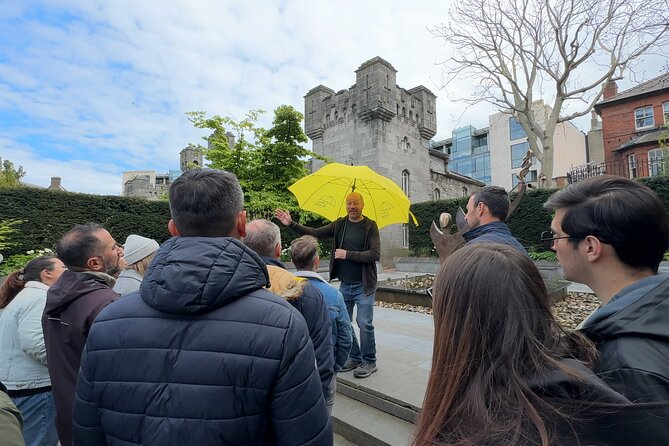
Dubh Linn Gardens offers a quieter pause after the cathedrals. The name connects with Dublin’s earlier identity, and the garden is described as the place where Vikings moored their longboats when they arrived in the ninth century. The Chester Beatty Library is also located here, giving you a useful option for later in your visit.
This is one of the more thoughtful stops on the route. A secluded garden can be easier to appreciate when a guide explains why this patch of ground matters. You get a break from the main streets, and the stop helps connect present-day Dublin with its earliest settlement.
From there, the route moves to Dublin Castle. The guide presents the castle as the center of British government in Ireland for 700 years, while also pointing out its unusual mix of medieval, Georgian, Gothic, and modern architecture. That mixture is one of the site’s key pleasures. It is not a single, neat castle complex in the storybook sense. It reflects layers of power and rebuilding.
Again, admission is not included. Ten minutes gives you a good exterior orientation and historical context, but you will need another visit to explore the state apartments or other interior areas. The guide’s explanation can help you decide if that extra time and admission cost fit your plans.
City Hall, the national flag, and Ireland’s political story
Near City Hall and the front gate of Dublin Castle, the tour turns from buildings to national symbols. The guide explains the significance of Ireland’s flag as a symbol of peace between Catholic and Protestant communities, and between North and South.
This is a valuable moment because it puts Dublin’s monuments into a wider political frame. You are not just looking at grand civic buildings. You are hearing about the divisions and hopes tied to Irish identity.
The stop is free and takes about ten minutes. It does not require special preparation, though you will get more from it if you are willing to ask questions. Several guides are praised for making space for questions and for linking Ireland’s political past with present-day Dublin.
More Walking Tours in Dublin
- Dublin Highlights and Hidden Gems Guided Walking Tour
★ 5.0 · 6,020 reviews - Dublin: Highlights and Hidden Gems Walking Tour
★ 4.9 · 2,140 reviews - 1916 Rebellion Walking Tour
★ 5.0 · 1,605 reviews - 90 Minute Dublin Walking tour and Sightseeing tips
★ 5.0 · 916 reviews
Temple Bar beyond the pub signs
Temple Bar is probably the stop you will recognize fastest. Today, the district is famous for pubs and nightlife, but the guide looks further back, explaining how the area was laid out during the Tudor conquest of Ireland.
That historical angle matters. Temple Bar can feel like a ready-made tourist district if you only see the signs, music venues, and busy lanes. The tour gives you a chance to understand the older street plan beneath the modern reputation.
The visit is free, and you spend roughly ten minutes in the area. You are not stopping for a drink or a meal, so keep your expectations focused on orientation. The practical value comes later, when you return to choose where to spend your evening.
Across the Liffey on Millennium Bridge
Millennium Bridge provides one of the clearest changes of view on the walk. After crossing from the south side to the north, the guide uses the river to frame Dublin from east to west. The story reaches back to the Celtic settlement said to have existed here 2,100 years ago and forward to the American influence behind the Silicon Docks.
That broad time span is typical of the tour. You get a short, readable version of Dublin’s development rather than a long lecture on one century. The bridge itself is free to cross, though the itinerary marks this stop as having no included admission because it is part of the walking route.
The river crossing also helps you understand Dublin’s layout. It is a small practical detail, but knowing how the Liffey divides the city makes later independent exploring much easier.
Ha’penny Bridge and Merchant’s Arch
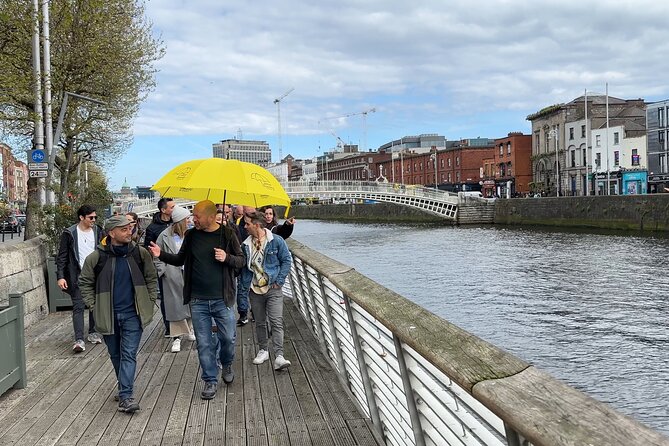
The return crossing takes place over the Ha’penny Bridge, one of Dublin’s most recognizable structures. The guide explains its former connection with the Duke of Wellington and notes the role of Harland & Wolff in making the bridge steadier underfoot.
This is a quick stop, but it has the kind of local detail that makes a familiar landmark more interesting. You are encouraged to look at the bridge as working infrastructure, not only as a photo background.
From there, the route reaches Merchant’s Arch and Crown Alley. The guide uses this area to show Dublin’s contrasts, placing Merchant’s Arch at one end and Sam Stephenson’s brutalist Stephenson Tower at the other.
I like this part because it avoids presenting Dublin as an old city frozen in time. Historic streets, modern office blocks, pub districts, civic buildings, and technology businesses all share the same center. The walk keeps asking you to compare them.
College Green and the final stop at Trinity College
College Green is one of the city’s most handsome urban spaces, with major bank and parliamentary buildings around it. The guide explains how it once served as a center of government and finance in a city that saw itself as the second city of the empire.
This is another stop where a short explanation adds real value. The architecture is easy to admire, but the political and financial setting tells you why these buildings were placed here and what Dublin wanted to project.
The route then pauses at the Molly Malone statue. No Dublin introduction would feel quite complete without greeting this famous figure, tied to the city’s popular song and identity. It is a light, familiar stop after the more serious political material.
The final stop is outside Trinity College Dublin, home to the Book of Kells exhibition. This is a practical ending. You finish at a major attraction rather than being left in an obscure corner of town, and you can decide if you want to visit Trinity immediately or return later.
Entry to Trinity and the Book of Kells exhibition is not included. The tour gives you context and a useful starting point, but you should allow separate time and money if the manuscript exhibition is a priority.
What the guides add to the walk
The strongest part of this experience is the guide’s role. Peter is repeatedly singled out for his historical detail, warm manner, clear answers, and helpful suggestions for the rest of a Dublin stay. Patrick is also praised for giving a concise account of the city and Ireland while answering questions well. Rob is described as conversational and engaging, particularly when a very small booking left him guiding just two people. Martin is noted for his energy and enthusiasm.
That range matters because a walking tour depends heavily on presentation. The route is fixed, but the experience can change with the guide and the questions in your group. You should expect stories about language, politics, religion, architecture, and modern Dublin, along with suggestions for museums and walks to tackle afterward.
The guides also appear willing to adjust the conversation. One account describes a guide checking if anyone needed to be somewhere after the tour and helping with onward plans. That is a small but useful sign of practical awareness.
Price, group size, and what you actually receive
At $20.52 per person, this is a low-cost way to get a guided introduction to central Dublin. You are paying for roughly two hours of route planning, explanation, local context, and the chance to ask questions. You are not paying for cathedral entry, Dublin Castle admission, the Book of Kells exhibition, food, or transport.
The value is best if you are visiting Dublin for a short break or on your first morning in the city. Use the walk to mark the places you want to revisit, then spend your admission money only where your interests are strongest. If you already know central Dublin well, the tour may feel too basic.
The maximum group size is 25. That is still manageable for a city walk, but it is not the same as a private tour or a group of six. If the booking is lightly filled, the guide can give more room to personal questions. The experience has sometimes operated with only one or two people, but you should not assume that will happen on your date.
The walk begins at 10:00 a.m. at 121 R137, Wood Quay, and ends at Fox House, 37 College Green, outside Trinity College’s front gate. Confirmation arrives when you book, and the activity is offered in English with a mobile ticket.
Who should book this Dublin walk
I would choose this tour if you want a fast, guided orientation before exploring alone. It suits first-time visitors, short-break planners, solo visitors who want conversation, and anyone who prefers history with their sightseeing.
It is also a good fit if you want to make better choices about paid attractions. Seeing the cathedrals, castle, Chester Beatty Library area, and Trinity College from the outside lets you decide where your limited time and budget should go.
I would think twice if you want long interior visits, a slow photography walk, or a highly intimate small-group experience guaranteed on every departure. The tour is broad rather than detailed, and its success depends in part on the guide’s storytelling and the size of the group.
Most people can participate, service animals are allowed, and the starting area is near public transportation. The route is in central Dublin, so you should expect a city walk rather than transport between stops. Free cancellation is available until 24 hours before the start time. After that point, the payment is not refunded, and changes are not accepted.
Should you book it?
Book this tour if you want to understand Dublin’s center quickly, hear the stories behind its major sights, and finish with a clear plan for the rest of your visit. At $20.52, it offers good value as a first-day framework, especially when Peter, Patrick, Rob, or Martin turns the route into a conversation rather than a string of facts.
Skip it if you mainly want to go inside the cathedrals, Dublin Castle, or Trinity College. In that case, put the two hours toward self-guided visits and pay the entry fees directly. For everyone else, this is a sensible, affordable introduction to Dublin’s old center, with enough local context to make your next walk more rewarding.
FAQ
How long does the walking tour last?
The tour lasts approximately two hours.
What time does the tour start?
The tour starts at 10:00 a.m.
Where does the tour begin?
The meeting point is 121 R137, Wood Quay, Dublin, Ireland.
Where does the tour end?
The tour ends at Fox House, 37 College Green, Dublin 2, outside the front gate of Trinity College.
Is admission to the attractions included?
No. Admission to Christ Church Cathedral, St. Patrick’s Cathedral, Dublin Castle, Trinity College, and the Book of Kells exhibition is not included. Dubh Linn Gardens, City Hall, Temple Bar, College Green, and the Molly Malone stop are listed as free, while the bridges and other walking stops do not include an attraction ticket.
Is the tour offered in English?
Yes. The experience is offered in English.
How many people can join the tour?
The maximum group size is 25 people.
Can I cancel for a full refund?
Yes, if you cancel at least 24 hours before the experience starts. Cancellations made less than 24 hours before the start time are not refunded, and changes made within that period are not accepted.
Recently added around Dublin
- Dublin: Pub Tour. Pour The Perfect Guinness, Whiskey & Music★ 5.0 · 3 reviews
- Waterford Crystal and Kilkenny Full-Day Rail Tour from Dublin★ 5.0 · 3 reviews
- Cliffs of Moher and The Burren Private Tour from Dublin★ 5.0 · 3 reviews
- Private Chauffeur Service From Dublin Airport to Killarney★ 5.0 · 3 reviews
- A Self Guided Walking Tour of Dublin’s Docklands★ 4.5 · 3 reviews
- Beautiful Southwest Tour 2022★ 5.0 · 3 reviews
- Dublin One Day Tour with a Local: 100% Personalized & Private★ 4.5 · 3 reviews
- Ireland: 3-Day West Coast Explorer Tour★ 5.0 · 3 reviews
Dublin Tours, compared.

Dublin to Cliffs of Moher, including Wild Atlantic Way and Galway
Read our review →
Cliffs of Moher, Burren & Galway City Day Tour
Read our review →

Dublin to Belfast Black Cab, Dunluce Castle and Giant’s Causeway
Read our review →
Kilkenny, Wicklow Mountains & Glendalough Day Tour from Dublin
Read our review →
Wicklow Mountains, Glendalough & Kilkenny Tour
Read our review →

Dublin Highlights and Hidden Gems Guided Walking Tour
Read our review →Browse the lists this tour appears in