
Reviewed · DUBLIN TOURS
2 Hour Walking Tour of Dublin’s City Centre
Dublin’s story comes together quickly on this two-hour city-centre walk, linking medieval churches, former seats of power, Georgian streets, and the lively Temple Bar area. Guides such as Alin, Alan, and Leonor use questions, quizzes, old photographs, and local suggestions to keep the past from turning into a lecture.
I like the small maximum group of 10, which makes it easier to hear the guide and ask questions. I also like the route’s practical shape: it begins near the Gaiety Theatre and finishes at St. Stephen’s Green, so you can use the walk to get your bearings on your first day.
The main consideration is simple: this is a highlights walk, not a series of long interior visits. Several stops include admission fees, and the fifteen-minute timing at each landmark gives you an introduction rather than time for a full look inside.
Key points to know before booking
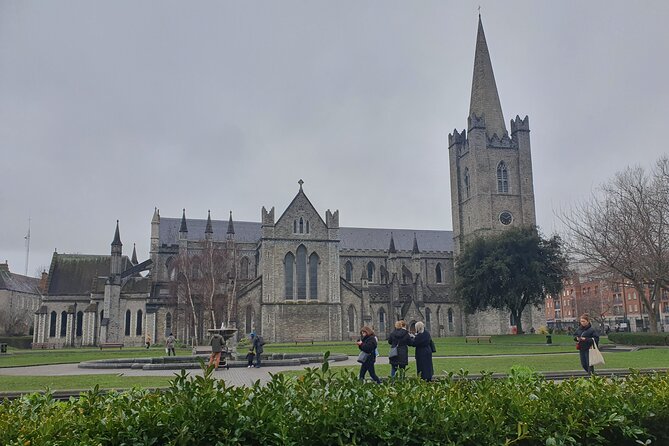
- Eight central Dublin sights: The route covers the Gaiety Theatre, St. Patrick’s Cathedral, Dublin Castle, Christ Church Cathedral, Temple Bar, Trinity College, the Bank of Ireland, and St. Stephen’s Green.
- Small-group format: The tour accepts no more than 10 people, though some departures may be even smaller or become private tours.
- Good first-day activity: Morning and afternoon start times let you fit the walk around other plans.
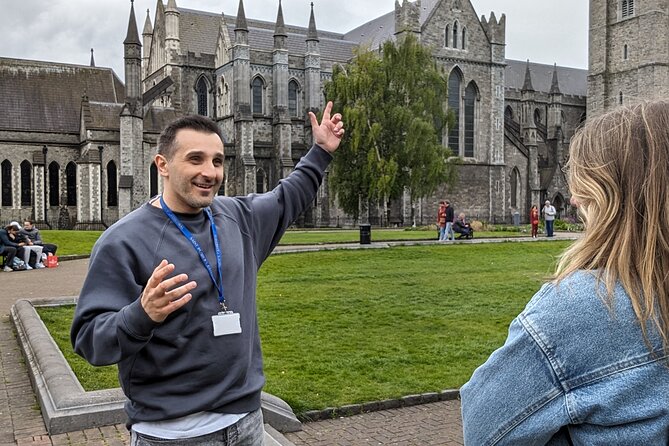
- Story-led guiding: Guides use photos, questions, quizzes, and games, with Alin and Alan receiving especially warm praise for their approach.
- Exterior sightseeing focus: The cathedral and castle visits are mainly introductions from outside, with admission not included.
- Easy transport connections: The walk ends at Fusiliers Arch beside the Luas stop on Grafton Street.
Why this works as a first look at Dublin
Dublin can feel easy to walk around, but its sights do not always explain themselves. A church may look like a medieval survivor, while the building beside it tells a story about British rule, Irish politics, or nineteenth-century restoration. This tour gives you the connections early.
You move through the old heart of the city rather than covering distant districts. That keeps the pace manageable and leaves you with useful landmarks for later. If you plan to visit St. Patrick’s Cathedral, Christ Church Cathedral, Dublin Castle, or the Book of Kells afterward, the guide helps you decide where to spend your limited time.
The route also gives you a mix of serious history and everyday Dublin. You hear about medieval rulers and the Act of Union, then move through Temple Bar’s pubs and galleries before reaching the green space of St. Stephen’s Green. That range is valuable because Dublin is not only a museum city. It is a living capital with layers that sit close together.
The small group matters here. With up to 10 people, the guide can answer questions without stopping the entire group for long. Some departures have had only two participants, which can turn the walk into a private-style introduction. You should not count on that, but the low group limit gives the experience a more personal feel than a large coach tour.
More City Tours in Dublin
- From Dublin: Cliffs of Moher, Burren & Galway City Day Tour
★ 4.8 · 18,888 reviews - Dublin: Cliffs of Moher, Atlantic Edge & Galway City
★ 4.7 · 4,293 reviews - Dublin to Rock of Cashel, Cork City & Blarney Castle Guided Tour
★ 4.5 · 2,536 reviews
Starting at the Gaiety Theatre
The meeting point is the Gaiety Theatre on King Street South in Dublin 2. This is a useful place to begin because it sits near several central sights and is easy to use as a fixed reference point.
The opening stop sets the tone. Rather than simply pointing at the theatre and moving on, the guide uses Dublin’s landmarks to bring the city’s past into the walk. You get a short introduction before heading toward the older religious and political buildings.
The schedule allows about 15 minutes at the Gaiety Theatre. That is enough for orientation and explanation, but not for a performance or a detailed theatre visit. Admission is free as part of the walking route, and the real purpose is to start the story in central Dublin before moving toward the medieval core.
Arrive with comfortable shoes and a little time to find the meeting point. The tour is only two hours, so a late arrival can make the first section feel rushed.
St. Patrick’s Cathedral and Dublin’s religious past
St. Patrick’s Cathedral gets about 15 minutes. The stop introduces its connection with St. Patrick and traces a complicated path from an Anglo-Norman building to near ruin, followed by rescue linked to the Guinness family.
That short account gives you a useful way to view the cathedral. It is not just a grand church for photographs. It also reflects changes in power, faith, money, and the care of old buildings. The guide’s job here is to explain those shifts without burying you in dates.
Admission is not included, so you should treat this as an exterior introduction unless you choose to return later and pay to enter. That arrangement works well for a first outing because you can see the setting, hear why it matters, and save the interior for a quieter visit.
The fifteen-minute limit is also the drawback. If you want time to study the architecture or explore the cathedral at length, you will need to come back on your own.
Dublin Castle, from tower to seat of power
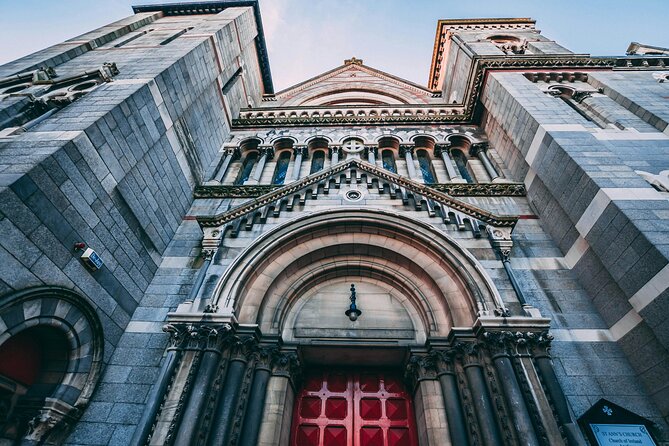
Dublin Castle receives another 15-minute stop. Its story begins with Anglo-Norman construction and a simple tower, then grows into a larger complex used as a centre of authority and a prison. The site also has a more unusual tale involving a daring jewel heist.
This is the kind of stop where a good guide adds real value. The buildings do not always reveal how their roles changed over time, and a short story can help you understand why the castle matters to Ireland’s political past.
Admission is not included. You will mainly get the setting and the historical explanation during the walk, with the option of returning for a longer visit. If you have only one day in Dublin, this introduction helps you decide if the castle deserves a place on your later schedule.
I would pay close attention to the guide’s explanation here rather than trying to take in every architectural detail at once. The route moves on fairly quickly, and the castle’s significance comes more from its changing role than from a single view.
More Walking Tours in Dublin
- Dublin Highlights and Hidden Gems Guided Walking Tour
★ 5.0 · 6,020 reviews - Dublin: Highlights and Hidden Gems Walking Tour
★ 4.9 · 2,140 reviews - 1916 Rebellion Walking Tour
★ 5.0 · 1,605 reviews - 90 Minute Dublin Walking tour and Sightseeing tips
★ 5.0 · 916 reviews
Christ Church Cathedral and the medieval city
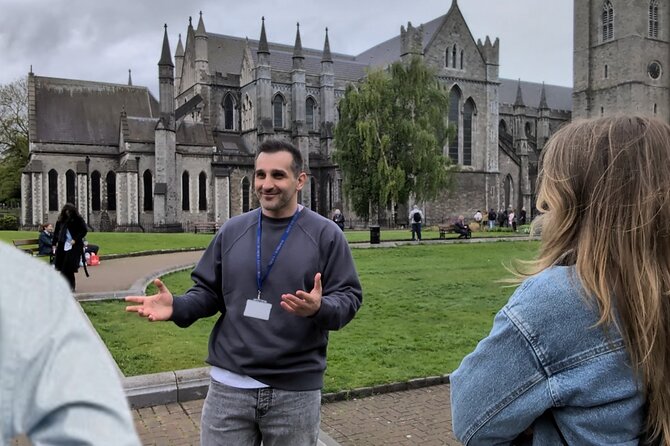
Christ Church Cathedral was founded by Vikings in 1030, making it one of the most useful stops for understanding Dublin before the modern city took shape. Later Anglo-Norman rulers added Gothic elements, and the building underwent a nineteenth-century restoration funded through whiskey wealth.
That sequence gives the stop plenty of character. You are not looking at one perfectly preserved period. You are seeing a building altered by different rulers, eras, and sources of money.
The tour again allows about 15 minutes, and admission is not included. The guide can explain the main story and point out why the cathedral belongs on your Dublin list, but you will need a separate visit to explore the inside properly.
Christ Church and St. Patrick’s Cathedral appear close together in the city’s old centre, yet they tell different parts of Dublin’s story. Seeing both on one walk helps you compare them and avoids spending your first morning trying to work out how the main historic sites fit together.
Temple Bar, beyond the pub signs
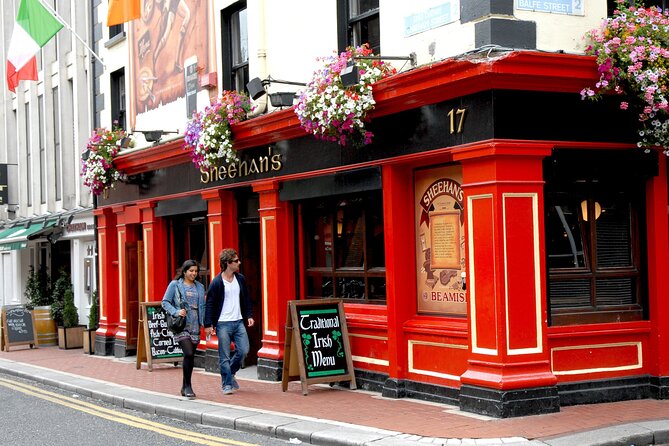
Temple Bar is the liveliest section of the route, but its current reputation can hide its past. The district was once a maze-like area with a poor reputation. Today, it is known for pubs, art galleries, nightlife, and heavy tourist traffic.
A guide can help you look past the obvious pub fronts. The stop gives context for how the area changed and why it became such a famous part of Dublin. You also get a chance to ask about places to eat and drink, which several participants found useful.
The stop is free and lasts about 15 minutes. That is enough for a quick orientation, not a full evening in the area. I would use the guide’s suggestions as a starting point, then decide for yourself where to return. Temple Bar is convenient and atmospheric, but prices can vary, and its tourist focus may not suit every meal or drink.
This is also one of the places where the walk’s timing makes sense. You see the district in daylight, learn how it developed, and can return later if you want to experience its nightlife.
Trinity College and the Book of Kells
Trinity College Dublin follows Temple Bar and provides a change of mood. The college has a turbulent past but is now a major centre of learning, best known to many visitors for the Book of Kells and its handsome campus.
The tour gives you an introduction rather than a Book of Kells visit. Admission is not included, and the 15-minute stop is not enough for a full campus exploration or the library experience. That distinction matters if the manuscript is high on your list.
Still, seeing Trinity as part of a walking route is useful. You understand where it sits in relation to Temple Bar, the old city, and Grafton Street. The guide can also place the college in Dublin’s wider story, rather than treating it as an isolated photo stop.
If you plan to visit the Book of Kells, consider using this tour to learn the layout and then returning when you have more time. The walk helps you choose, but it does not replace the ticketed visit.
The Bank of Ireland and the old Parliament House
The Bank of Ireland stop focuses on the building’s former political role. This was once the Old Parliament House, connected with Irish politics, architectural influence, and the Act of Union.
For me, this is one of the more useful stops because it links a familiar city-centre building to major political change. A bank can look like a financial institution, but its earlier life gives it a very different meaning.
Admission is free on the walking tour, and the 15-minute visit is mainly about the exterior and the story attached to it. You do not need a long stop to understand the basic importance of the building, though anyone interested in Irish political history may want more time afterward.
The route’s strength is clear here: you do not need to make a separate plan for every important building. The guide connects them as you walk.
Finishing at St. Stephen’s Green
The final stop is St. Stephen’s Green, a public park with an earlier life as an exclusive green space for Dublin’s elite. The Guinness family helped make it available to the public, and it is now enjoyed by everyone.
This is a pleasant finish after the denser medieval and political material. The park gives you open space, a chance to slow down, and a practical place to continue your day. The walk ends at Fusiliers Arch, the grand entrance on Grafton Street.
The endpoint is especially convenient because it is beside the Luas tram stop. You can continue shopping around Grafton Street, reach another part of the city by tram, or use the park as a quiet break.
The official endpoint is listed as 3 St. Stephen’s Green, with the guide finishing at the arch. Pay attention to that distinction when arranging a pickup or meeting someone afterward.
The guides and the style of the walk
The strongest part of the experience is the guiding style. Alin and Alan are repeatedly praised for being personable, well informed, and easy to follow. Leonor is also singled out for providing an excellent guiding experience.
That does not mean the walk is a formal academic lecture. The approach is more active. Guides use questions, quizzes, games, and old photographs. One guide carried a binder of historic photos, helping you compare old Dublin with what you see in front of you.
This style can work well for mixed-age groups. A family with children aged 11, 13, and 15 found the games kept everyone involved, while another group spanning ages 22 to 73 found the experience enjoyable for all. You should expect interaction rather than simply walking behind someone who recites facts.
The guides also make room for questions and photographs. That flexibility is useful, though it may mean the exact pace varies. If your group wants many photos or extra questions, the guide may adjust the route or timing. That is a benefit for most people, but anyone seeking a tightly timed checklist should allow for a little variation.
Price, timing, and what you get for $28.96
At $28.96 per person, the tour is priced as a low-cost orientation rather than an all-inclusive sightseeing package. You are paying for two hours with an English-speaking guide, a planned route, local context, and the convenience of seeing eight major city-centre sights without navigating them yourself.
The price does not include entry fees or taxes. That means you should add the cost of any cathedral, castle, or Book of Kells visit you choose to make later. In practical terms, the tour is good value if you want help deciding which paid attractions deserve your time.
It is less suitable if you want admission to several interiors included in one ticket. The route covers a lot of ground, but most stops are short. Think of it as a map in story form, with useful recommendations attached.
Morning and afternoon departures give you flexibility. I would choose the morning if you want to use the guide’s suggestions for the rest of the day. An afternoon start can work well if you arrive late or prefer a slower first morning.
The tour is booked an average of 33 days ahead, so advance planning is sensible during busy periods. Confirmation arrives at booking, and free cancellation is available up to 24 hours before the start time. Changes or cancellations inside that window are not accepted for a refund.
Walking comfort and group size
You need a moderate level of physical fitness. The experience lasts about two hours and takes place on foot through central Dublin. The information does not specify the exact distance or the number of scheduled breaks, so wear shoes you can use comfortably for continuous city walking.
Service animals are allowed, and the meeting and ending points are near public transport. The tour is offered in English, which is important to note when comparing it with multilingual options.
A maximum of 10 people is a real advantage. You can hear the guide more clearly, ask questions, and stay connected to the group at busy city-centre sights. On particularly small departures, the guide may tailor the discussion to your interests, but a private tour is not guaranteed.
Who should book this Dublin walk?
I would choose this tour for a first visit, especially if you want a quick orientation before spending money on major attractions. It suits solo visitors, couples, families, and anyone who prefers stories and conversation to a self-guided route.
It is also a good match if you want restaurant and pub suggestions beyond the most obvious tourist choices. The guides have offered local eating advice and pointed out places outside the main tourist circuit.
Families may appreciate the quizzes and games. History-minded visitors will like the links between Viking Dublin, Anglo-Norman rule, Irish politics, religious buildings, and the Guinness family. Even if you already know the main landmarks, the old photos and less familiar anecdotes can add something.
I would not book it as your only Dublin sightseeing activity if you want long interior visits. The tour shows you where the main sights are and explains why they matter, but you must schedule and pay for the interiors separately.
Should you book the 2 Hour Walking Tour of Dublin’s City Centre?
Book it if you want a friendly, compact introduction to Dublin with a small group and a guide who keeps the history active. Alin and Alan appear to be particularly strong at mixing facts with questions, games, photos, and practical advice, while Leonor is another named guide associated with the experience.
The best plan is to take it early in your stay, then use the remaining hours or days to revisit the places that interest you most. At $28.96, it offers a sensible way to get your bearings without committing to a costly full-day tour.
Skip it if you have already explored central Dublin carefully or if your main goal is included entry to the cathedral, castle, and Book of Kells. For a first look at the city’s central sights, though, this is a well-paced and useful choice.
FAQ
How long does the Dublin city-centre walking tour last?
The tour lasts approximately two hours.
How much does the tour cost?
The listed price is $28.96 per person.
Where does the tour begin?
The meeting point is the Gaiety Theatre on King Street South, Dublin 2, Ireland.
Where does the tour finish?
The tour ends at Fusiliers Arch in St. Stephen’s Green, listed as 3 St. Stephen’s Green, Dublin, D02 X025.
Is the ending near public transport?
Yes. Fusiliers Arch is beside the Luas tram stop on Grafton Street.
Which sights are included in the walking route?
The route includes the Gaiety Theatre, St. Patrick’s Cathedral, Dublin Castle, Christ Church Cathedral, Temple Bar, Trinity College Dublin, the Bank of Ireland, and St. Stephen’s Green.
Are entrance fees included?
No. Admission fees and taxes are not included. The cathedral, castle, and other ticketed attractions may require separate payment.
Is the tour available in English?
Yes. The tour is offered in English.
How many people can join the tour?
The maximum group size is 10 people.
Can I cancel for a full refund?
Yes, if you cancel at least 24 hours before the experience start time. Cancellations or changes made less than 24 hours before the start time are not accepted for a refund.
More 2-Hour Experiences in Dublin
- 2-Hour Historical Walking Tour from Dublin
★ 5.0 · 875 reviews - Historical 2-Hour Guided Walking Tour of Dublin
★ 4.7 · 865 reviews - Dublin: 2-Hour Premium Whiskey and Food Tasting Tour
★ 4.7 · 54 reviews - Dublin: 2 Hour City Center Guided Walking Tour
★ 4.9 · 12 reviews
Recently added around Dublin
- Dublin: Pub Tour. Pour The Perfect Guinness, Whiskey & Music★ 5.0 · 3 reviews
- Waterford Crystal and Kilkenny Full-Day Rail Tour from Dublin★ 5.0 · 3 reviews
- Cliffs of Moher and The Burren Private Tour from Dublin★ 5.0 · 3 reviews
- Private Chauffeur Service From Dublin Airport to Killarney★ 5.0 · 3 reviews
- Beautiful Southwest Tour 2022★ 5.0 · 3 reviews
- A Self Guided Walking Tour of Dublin’s Docklands★ 4.5 · 3 reviews
- Dublin One Day Tour with a Local: 100% Personalized & Private★ 4.5 · 3 reviews
- Ireland: 3-Day West Coast Explorer Tour★ 5.0 · 3 reviews
Dublin Tours, compared.

Dublin to Cliffs of Moher, including Wild Atlantic Way and Galway
Read our review →
Cliffs of Moher, Burren & Galway City Day Tour
Read our review →

Dublin to Belfast Black Cab, Dunluce Castle and Giant’s Causeway
Read our review →
Kilkenny, Wicklow Mountains & Glendalough Day Tour from Dublin
Read our review →
Wicklow Mountains, Glendalough & Kilkenny Tour
Read our review →

Dublin Highlights and Hidden Gems Guided Walking Tour
Read our review →Browse the lists this tour appears in